


Many yoga teachers expect students to make decisions too quickly.
They share a poster.
They send a message.
They explain their classes.
And then they wait.
If the student does not join immediately, they often assume:
- the person is not interested
- the price is too high
- the marketing did not work
- the market is difficult
Sometimes that may be true.
But often, the student simply has not travelled far enough in the decision journey.
This is especially true in yoga.
People are not only buying a class.
They are choosing:
- a teacher
- a routine
- a space
- a community
- a relationship of trust
That decision usually takes time.
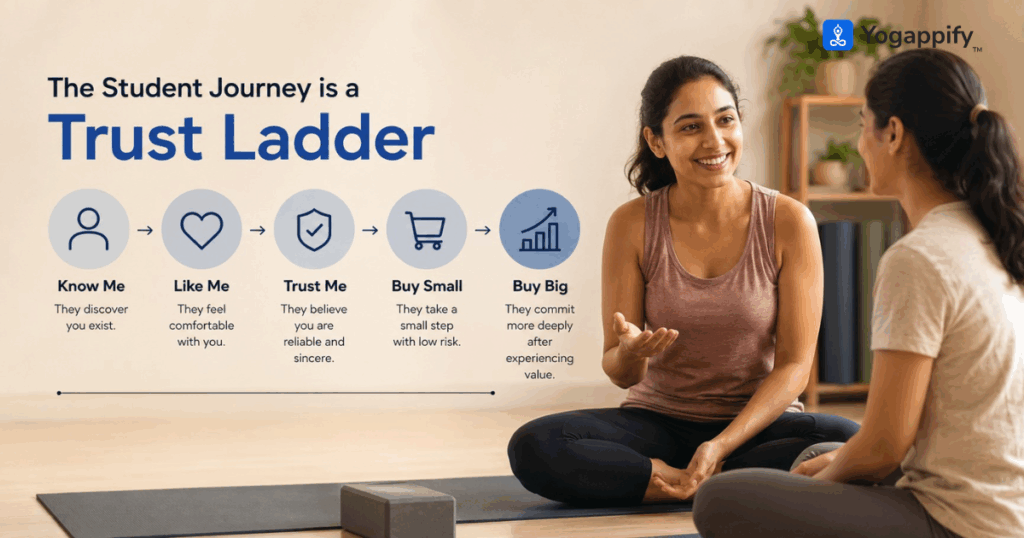
A simple way to understand this journey is:
Know Me → Like Me → Trust Me → Buy Small → Then Buy Big
The yoga student journey is a trust ladder. Students first become aware of a teacher, then feel comfortable, build trust, make a small financial commitment, and finally deepen that commitment after experiencing value.
This framework can help yoga teachers think about sales more patiently and more effectively.
Why Sales in Yoga Takes Time
When someone hears about your yoga classes for the first time, they may not join immediately.
That does not automatically mean they are rejecting you.
They may still be trying to understand:
- Who are you?
- What kind of teacher are you?
- Will I feel comfortable in your class?
- Will you understand my limitations?
- Is yoga really suitable for me?
- Can I trust this person?
- Will I be able to continue?
- Is this worth my time and money?
These are not small questions.
For many students, yoga is connected to health, body image, confidence, routine, ageing, stress, recovery, discipline, or emotional well-being.
So the decision is not purely logical.
It is personal.
This is why aggressive selling often does not work well in yoga.
A student may listen politely, but still hesitate.
Not because they dislike you.
But because trust has not yet matured.
Sales in yoga is not about forcing the student to jump.
It is about helping them climb the trust ladder one step at a time.
The Trust Ladder for Yoga Teachers
The trust ladder has five stages:
- Know Me
- Like Me
- Trust Me
- Buy Small
- Buy Big
Each stage has a different purpose.
Each stage needs a different kind of communication.
Each stage helps the student move from awareness to commitment.
Many yoga teachers make the mistake of trying to jump directly from:
Know Me → Buy Big
That is usually too big a leap.
A person who has just discovered you may not be ready to commit to a long package, a quarterly plan, or a full membership.
They may first need to understand you.
Then feel comfortable with you.
Then trust you.
Then take a small first step.
Then deepen their commitment.
This is not weakness.
This is how trust-based service businesses work.
Stage 1: Know Me
Stage 1: Know Me
The first stage is simple.
The student must know that you exist.
This is the visibility stage.
If people do not know you exist, they cannot enquire.
If they cannot enquire, they cannot join.
At this stage, your job is not to sell deeply.
Your job is to become visible to the right people.
This can happen through:
- WhatsApp sharing
- Instagram posts
- referrals
- Google Business Profile
- local community groups
- workshops
- beginner sessions
- simple videos
- blog posts
- word of mouth
This is where marketing for yoga teachers becomes important.
Marketing is not about becoming loud or pushy. It is about making sincere teaching visible to the right people.
At the Know Me stage, your communication should answer:
- Who are you?
- What do you teach?
- Whom do you help?
- Where or how do you teach?
- How can someone know more?
The goal is awareness.
Not pressure.
A student cannot trust you before they know you.
Stage 2: Like Me
AOnce people know you, they begin forming an impression.
They may see your posts.
They may read your message.
They may watch a short video.
They may hear someone speak about you.
They may attend a free session.
At this stage, they are silently asking:
- Do I feel comfortable with this teacher?
- Does this teacher’s style suit me?
- Does this communication feel warm or cold?
- Does this teacher sound clear?
- Do I feel safe approaching them?
- Do I like the energy of this person?
Likeability does not mean artificial friendliness.
It does not mean performance.
It does not mean trying to please everyone.
It means genuine human ease.
A student should feel that approaching you will be comfortable.
This is where your communication, tone, patience, and warmth matter.
A teacher may be highly knowledgeable, but if the student feels intimidated, confused, or judged, they may not move forward.
This is why your Likeability Index matters.
Students do not experience only your knowledge.
They also experience you.
When your communication feels respectful, warm, steady, and human, the student becomes more open to the next stage.
Stage 3: Trust Me
A person may know you.
They may even like you.
But they still need to trust you before making a meaningful commitment.
Trust builds slowly.
It grows through:
- consistent communication
- clear class information
- professional follow-up
- honest answers
- testimonials
- student experiences
- reliability
- calm confidence
- service mindset
Trust also grows when your communication matches your delivery.
If you speak about care but respond carelessly, trust weakens.
If you promise structure but remain disorganised, trust weakens.
If you show consistency over time, trust strengthens.
This is why professional presence as a yoga teacher matters.
Students often decide not only based on your yoga knowledge, but also on how dependable the overall experience feels.
A simple experience of your class can also help strengthen trust.
This can mean:
- one or two free sessions
- a trial class
- a free beginner session
- a simple introductory event
- a short webinar
- a small group experience
These are trust-building steps.
They help the student feel more comfortable and confident before making a financial commitment.
The Trust Me stage is not about proving that you are perfect.
It is about helping the student feel safe enough to begin.
Stage 4: Buy Small
One common mistake yoga teachers make is expecting a large financial commitment too early.
A new student may hesitate to:
- pay for a long package
- join a three-month program
- commit to a large batch
- change their routine immediately
- trust a teacher they have not yet experienced
- pay a high fee before understanding value
This hesitation is understandable.
The person has not yet experienced:
- your teaching
- your style
- the class environment
- the benefits
- the community
- the rhythm of the practice
So allow them to begin with a small financial commitment.
This can mean:
- a beginner workshop
- a short introductory package
- a 7-day paid program
- a low-cost starter plan
- a small monthly entry package
- a one-time paid trial session
The goal is not to undervalue your work.
The goal is to make the first financial decision easier.
A small paid commitment gives the student a chance to experience your value more seriously.
Free sessions can build trust.
But a small paid step creates commitment.
This is an important bridge.
The student is no longer only interested.
They have begun participating.
Stage 5: Buy Big
Once the student experiences value, trust begins to deepen.
They may notice:
- better energy
- improved flexibility
- more calmness
- a sense of belonging
- greater confidence
- comfort with your teaching style
- improved regularity
- stronger connection with the practice
Now a larger commitment becomes easier.
This may mean:
- a monthly membership
- a quarterly package
- regular classes
- personal sessions
- workshops
- referrals to friends and family
- deeper programs
- long-term student relationship
The larger purchase is not forced.
It becomes a natural progression.
This is a much healthier way to grow.
The student is not pushed into a commitment before trust exists.
They are invited to continue after value has been experienced.
This is why sales is not convincing; it is clarifying.
The teacher’s job is not to pressure the student into buying big.
The teacher’s job is to help the student understand the next right step.
Why Sales in Yoga Is Different from Other Businesses
Yoga is not usually an impulse purchase.
It is often a habit-building journey.
And habits grow through:
- comfort
- consistency
- trust
- repeated experience
- gentle encouragement
- visible personal benefit
This is why aggressive selling often does not work well in yoga businesses.
It may create a short-term conversion.
But it can weaken long-term trust.
A patient, structured approach works better because it respects the student’s journey.
The teacher is not selling only a class.
The teacher is inviting the student into a practice.
That invitation needs care.
It needs clarity.
It needs timing.
It needs trust.
Why Direct Selling Alone Often Fails
Direct selling is not wrong.
There are times when a clear invitation is necessary.
If a student has attended a trial class, asked questions, and shown interest, it is perfectly fine to say:
“This batch may be suitable for you. Would you like to join from Monday?”
That is not pressure.
That is clarity.
But if every message is only a direct selling message, trust may not grow.
Students also need:
- educational messages
- reminders
- helpful insights
- reassurance
- stories from other students
- simple explanations
- clarity about the class
- time to think
Follow-up does not always need to be a direct sales message.
Sometimes a useful educational message works better.
For example:
- sharing a simple yoga tip
- sending a helpful health insight
- forwarding a relevant blog
- sharing a student success story
- reminding them about a beginner-friendly session
This keeps the relationship warm without creating pressure.
A good sales journey is not only about asking people to join.
It is also about helping them feel ready.
Follow-Up Is Often an Act of Service
Many yoga teachers avoid follow-up because they fear sounding commercial.
But people delay many good decisions in life:
- exercise
- meditation
- therapy
- sleep improvement
- yoga
- healthier routines
Not because these things lack value.
But because human beings naturally procrastinate, hesitate, and overthink.
A gentle follow-up often helps people move through this emotional resistance.
And honestly, many of us have moved forward in life because someone patiently encouraged us at the right time.
A follow-up can be simple:
“Namaste. Just checking if you had a chance to think about the beginner batch. If you have any questions about timing, suitability, or fees, I will be happy to clarify.”
This is not pressure.
This is support.
At least two or three gentle follow-ups at proper intervals are reasonable unless the person clearly says they are not interested.
And if someone is hesitating, try to understand the obstacle.
For example:
- if price is becoming a barrier, consider a beginner offer
- if confidence is low, offer an additional free session
- if reassurance is needed, let them speak to an old student
- if timing is difficult, suggest another batch
- if the person feels unsure, explain the class flow gently
This is not chasing.
This is guidance.
Authenticity Converts Better Than Pressure
Especially in yoga businesses.
People are usually not looking for:
- flashy sales language
- exaggerated claims
- artificial urgency
- pressure tactics
- dramatic promises
They are looking for:
- trust
- clarity
- sincerity
- steadiness
- belonging
- confidence
A calm teacher who communicates clearly often creates more confidence than someone trying too hard to impress.
Students can usually sense authenticity.
And they can also sense pressure.
This does not mean you should become passive.
It means your confidence should come from belief in the value of what you offer.
Not from force.
Not from fear.
Not from urgency.
But from genuine conviction.
Confidence Matters Too
Some yoga teachers misunderstand authenticity.
They become so hesitant about selling that they communicate weakly.
This also creates problems.
Being authentic does not mean:
- being vague
- sounding unsure
- avoiding invitations
- under-explaining your value
- apologising for your price
- leaving interested students confused
Students also look for confidence.
Not aggressive confidence.
But calm confidence.
The confidence that comes from genuinely believing in the value of what you offer.
A teacher can be humble and still be clear.
A teacher can be sincere and still invite.
A teacher can be service-oriented and still charge.
A teacher can be authentic and still follow up.
This balance is important.
Without confidence, students may hesitate.
With pressure, students may resist.
With calm clarity, students can trust.
Simple Systems Make This Easier
As your yoga business grows, it becomes difficult to remember every conversation manually.
You need simple systems to help you:
- track leads
- communicate clearly
- manage batches
- follow up gently
- onboard students smoothly
- maintain consistency
- send payment reminders
- organise student information
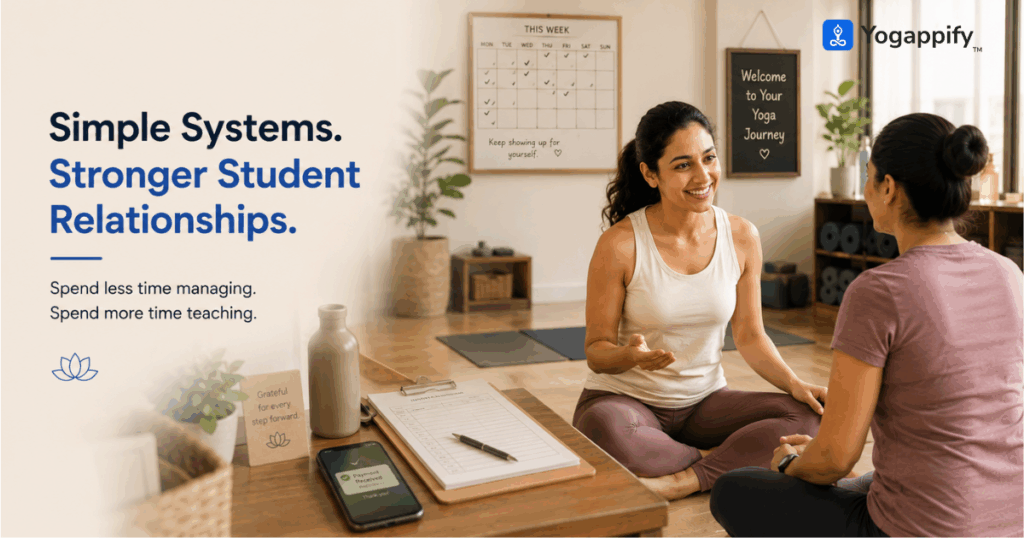
Simple digital tools can help you manage this journey without making your business complicated.
Yogappify helps yoga teachers manage leads, landing pages, batches, payments, follow-ups, and student communication in one structured flow. You can explore it at yogappify.com.
The idea is not to automate relationships.
The idea is to support relationships with structure.
When the student journey is organised, the teacher can guide people more calmly.
And when the teacher is calm, students feel safer.
A Simple Trust Ladder
You can think of the student journey like this:
- Know Me
The student becomes aware that you exist. - Like Me
The student feels comfortable with your style and communication. - Trust Me
The student begins to believe that you are sincere, reliable, and capable. - Buy Small
The student takes a low-risk first step with a small financial commitment. - Buy Big
The student commits more deeply after experiencing value.
This framework is simple.
But it explains why random promotion often fails.
It also explains why patient communication often works better than repeated pressure.
Many yoga teachers do not need more aggressive sales.
They need a clearer trust ladder.
A Quiet Reflection
If a student has not joined yet, do not immediately assume they are uninterested.
Ask yourself:
- Do they know me well enough?
- Do they feel comfortable with me?
- Do they trust my approach?
- Have I given them an easy first step?
- Have I stayed in touch without creating pressure?
- Have I clarified their doubts?
- Have I made the next step simple?
- Am I asking for too big a commitment too soon?
Sometimes the right answer is not more selling.
It is more patience.
More clarity.
More reassurance.
More structure.
Frequently Asked Questions
What does Know Me, Like Me, Trust Me mean?
Know Me, Like Me, Trust Me means that students usually move through stages before making a purchase. They first become aware of a teacher, then feel comfortable with the teacher’s style, then build trust before making a commitment.
Why should yoga teachers offer small first steps?
Small first steps such as beginner workshops, short introductory packages, paid trial sessions, or low-cost starter plans help students experience value before making a larger commitment.
How can yoga teachers build trust with students?
Yoga teachers can build trust through consistent communication, clear class information, reliable follow-up, honest answers, student stories, introductory experiences, and a smooth onboarding journey.
Should yoga teachers avoid direct selling?
Not necessarily. Direct selling is fine when it is honest, relevant, and respectful. But value-based communication, patient trust-building, and gentle follow-up often create stronger long-term relationships.
Why is follow-up important in yoga businesses?
Follow-up helps students overcome hesitation, ask questions, and move forward when they are ready. It works best when it is calm, relevant, useful, and respectful.
Final Thought
In yoga businesses, the time taken to convert students can be longer than many teachers expect.
Yoga is a service-first, trust-first business.
Students do not always need more pressure.
Often, they need:
- familiarity
- comfort
- reassurance
- a simple first step
- time
Build trust patiently.
Help students know you.
Help them feel comfortable with you.
Help them trust you.
Give them a small first step.
Then, after they experience value, the larger commitment will often follow naturally.
That is the secret of sales in yoga.
Author
Vishal Ganeriwal
Vishal Ganeriwal is an entrepreneur, business strategist, and MSME mentor with nearly three decades of experience in building, managing, and growing businesses. He is part of the founding team and currently Chief Business Officer of Yogappify™, a Success Platform designed to help yoga teachers build more organised, sustainable, and professionally managed businesses. His work brings together practical business strategy, digital marketing, technology, coaching, and grassroots understanding of Indian small businesses. A long-time practitioner and certified trainer of Heartfulness meditation, Vishal believes that business growth should remain rooted in authenticity, service, and human wellbeing. Through his writing, he simplifies marketing, sales, systems, and entrepreneurship for yoga teachers who may not have a formal business background. His perspectives are shaped by lived business experience, continuous experimentation, and close engagement with independent teachers and small yoga studios. He writes to help yoga professionals earn with dignity, work with greater clarity, and create a wider positive impact through their teaching.