

Why Good Teaching Still Needs Visibility
Many yoga teachers feel uncomfortable with the word marketing. Marketing for yoga Many yoga teachers feel uncomfortable with marketing.
They are comfortable teaching. They are comfortable guiding students. They are comfortable learning, practising, and improving their craft.
But when it comes to promoting themselves, something changes.
They hesitate.
They worry that marketing may make them look commercial. They fear that talking about their classes may feel pushy. They may even feel that if their teaching is good, students should somehow find them naturally.
This belief is understandable.
But it can quietly keep good teachers invisible.
Marketing for yoga teachers is not about shouting louder. It is not about becoming artificial. It is not about copying influencers or turning yoga into a product.
Marketing is simply the visibility of service.
If your teaching can genuinely help someone, but that person does not know you exist, your sincerity alone cannot help them.
Good teaching matters deeply.
But invisible excellence helps no one.
Why Marketing Feels Difficult for Yoga Teachers
For many yoga teachers, marketing feels uncomfortable because it appears to conflict with the spirit of yoga.
Yoga is associated with humility, service, discipline, inner growth, and sincerity.
Marketing, on the other hand, is often associated with noise, exaggeration, self-promotion, and selling.
So the teacher feels caught between two worlds.
One part says:
“I want to help people.”
Another part says:
“I do not want to promote myself.”
This conflict is real.
But it comes from a narrow understanding of marketing.
Marketing does not have to be manipulation.
Marketing does not have to be pressure.
Marketing does not have to be performance.
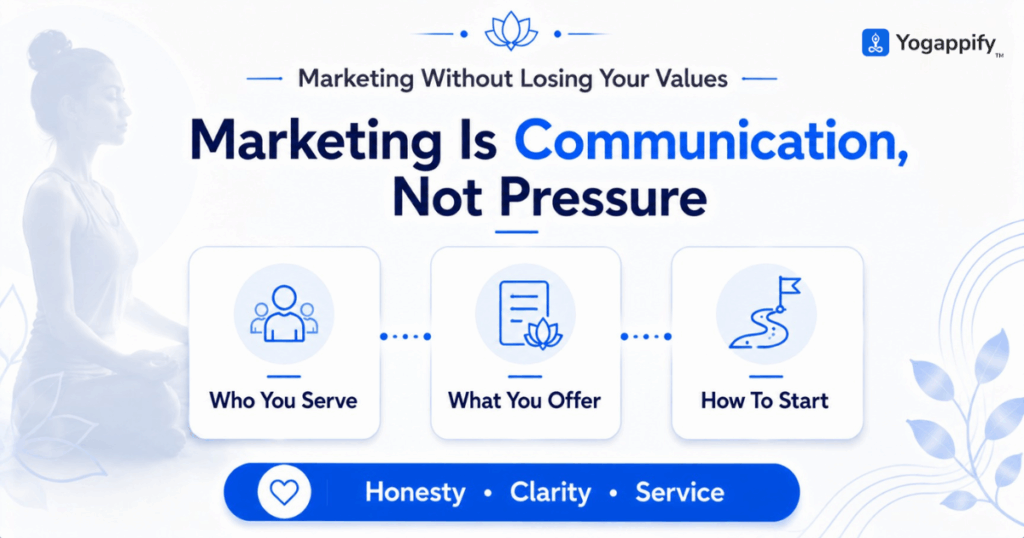
At its best, marketing is communication.
It helps the right people understand:
- who you are
- whom you serve
- what you offer
- how your classes may help
- how they can take the next step
When marketing is done with honesty and care, it becomes part of service.
Marketing Is Not Opposite to Yoga
A yoga teacher does not need to become aggressive to market well.
A teacher does not need to promise miracles.
A teacher does not need to dance on trends, copy loud content, or use fear-based messaging.
The real question is simpler:
Can the people who need your help understand that you can help them?
If the answer is no, marketing is needed.
Not because you want attention.
But because clarity creates access.
A senior citizen looking for gentle mobility yoga may not find you unless you say clearly that you teach this.
A working professional struggling with stress may not approach you unless your message speaks to that need.
A beginner who feels stiff and nervous may not join unless your communication feels safe and reassuring.
Marketing helps the right student recognise the right teacher.
That is not against yoga.
That is useful.
The First Shift: From Self-Promotion to Service Communication
Many teachers resist marketing because they think it means talking about themselves.
But useful marketing is not only about the teacher.
It is about the student.
Instead of asking:
“How do I promote myself?”
Ask:
“How do I help the right person understand that this class may support them?”
This shift changes the tone completely.
Now marketing becomes less about showing off and more about helping people make a clear decision.
Your message becomes:
- less about “Look at me”
- more about “This may help you”
- less about performance
- more about clarity
- less about pressure
- more about invitation
This is why branding for yoga teachers matters before marketing. When you are clear about who you are, whom you serve, and what you want to be known for, marketing becomes easier and more natural.
You are no longer trying to attract everyone.
You are trying to reach the right people.
What Should Yoga Teachers Communicate?
Many yoga teachers post randomly because they are not sure what to say.
One day they share a quote.
Another day they share a posture.
Another day they announce a batch.
Then they disappear for two weeks.
This is common.
But marketing becomes easier when you understand what your audience needs to know.
A yoga teacher should communicate five things clearly:
- Who you help
Are you helping beginners, working professionals, women above 40, senior citizens, children, corporate teams, or another specific group? - What problem or need you address
Is your class for stress, flexibility, mobility, posture, strength, calmness, recovery, focus, or general wellness? - How your class works
Is it online, offline, group, one-to-one, weekend-based, daily, beginner-friendly, slow-paced, energetic, therapeutic, or structured? - What students can expect
Will they experience personal attention, gradual progress, regularity, community, discipline, or gentle guidance? - How they can take the next step
Can they message you, join a trial class, fill a form, visit a landing page, or speak to you?
This is not complicated marketing.
This is clear communication.
Why Random Posting Does Not Build Trust
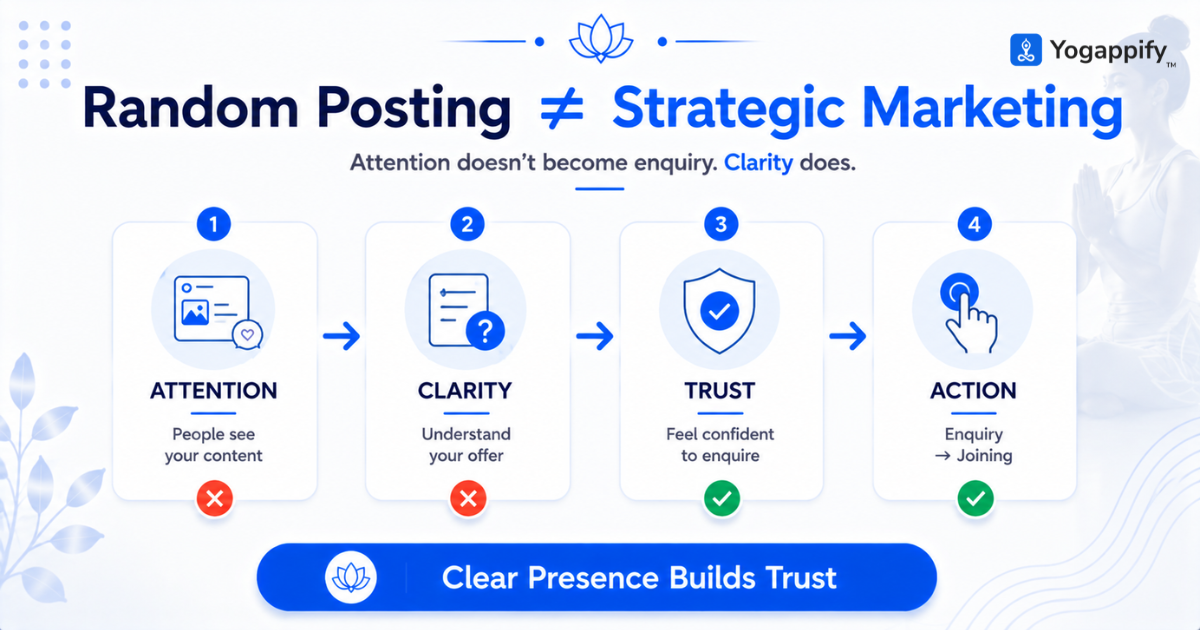
Posting frequently is not the same as marketing strategically.
If your content is random, students may enjoy it but still not understand your offer.
They may like your post but not know:
- whether you teach beginners
- whether classes are online or offline
- whether your batch is open
- what problem you help with
- what your fees are
- how to enquire
- whether the class is suitable for them
This creates a gap.
Attention does not automatically become enquiry.
Enquiry does not automatically become joining.
Marketing should reduce this gap.
This is where professional presence as a yoga teacher becomes important. A professional presence helps students understand your offering clearly and trust you before they even speak to you.
You do not need to appear corporate.
You need to appear clear, organised, and dependable.
The Second Shift: From Random Visibility to Repeated Clarity
Many teachers think marketing means always creating new content.
But often, marketing is about repeating the right message in different ways.
Students may need to hear your message several times before they act.
This does not mean you become irritating.
It means you become consistent.
If you teach yoga for stress relief, that theme should appear repeatedly.
If you teach beginner-friendly yoga, that should be visible again and again.
If you teach senior citizens, your content should consistently speak to mobility, confidence, balance, safety, and independence.
If you teach working professionals, your message should connect with stress, posture, energy, focus, and routine.
Repeated clarity builds memory.
Memory builds trust.
Trust leads to enquiry.
And enquiry becomes the beginning of a relationship.
Marketing Should Lead Somewhere
Good marketing should not stop at visibility.
It should create a clear next step.
If a person feels interested after seeing your post, what should they do?
Should they message you?
Should they register for a free session?
Should they join a WhatsApp group?
Should they visit a landing page?
Should they book a call?
Should they attend a beginner session?
Without a next step, marketing creates interest but not movement.
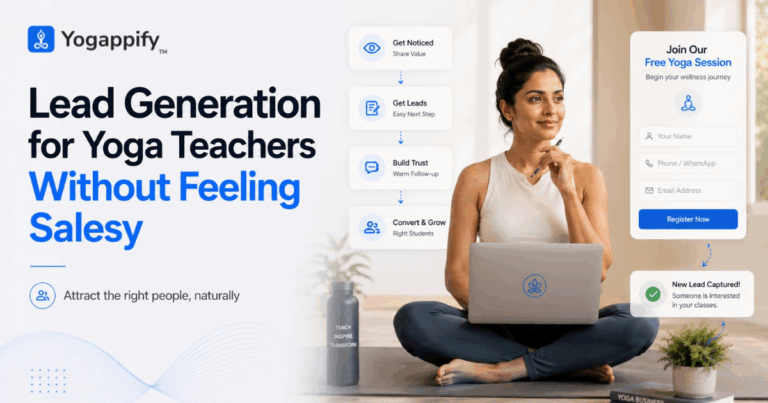
This is why lead generation for yoga teachers is important. Lead generation does not mean chasing people. It means giving interested people a simple way to raise their hand and begin a conversation.
Marketing creates visibility.
Lead generation creates the next step.
Both are needed.
The Third Shift: From “Everyone” to “Right People”
One reason yoga teachers feel stuck is that they try to speak to everyone.
Their message becomes too broad:
“Yoga is good for health.”
“Join my yoga class.”
“Yoga helps body and mind.”
These statements are true.
But they are not always specific enough to move someone.
A more specific message is easier to understand.
For example:
“Gentle Yoga for Senior Citizens Who Want Better Mobility and Balance”
is clearer than:
“Yoga for Everyone.”
“Beginner Yoga for Women Above 40”
is clearer than:
“Morning Yoga Class.”
“Desk Yoga for Working Professionals With Stiffness and Stress”
is clearer than:
“Online Yoga Session.”
This does not mean you cannot teach others.
It means your communication needs a clear doorway.
This is where niche clarity for yoga teachers becomes powerful. A niche helps the right student understand why your class is relevant to them.
Specificity does not reduce opportunity.
It improves recognition.
Where Simple Systems Can Help
As your marketing becomes clearer, more people may begin enquiring.
This is a good sign.
But it also creates a new responsibility.
You need a simple way to manage interest.
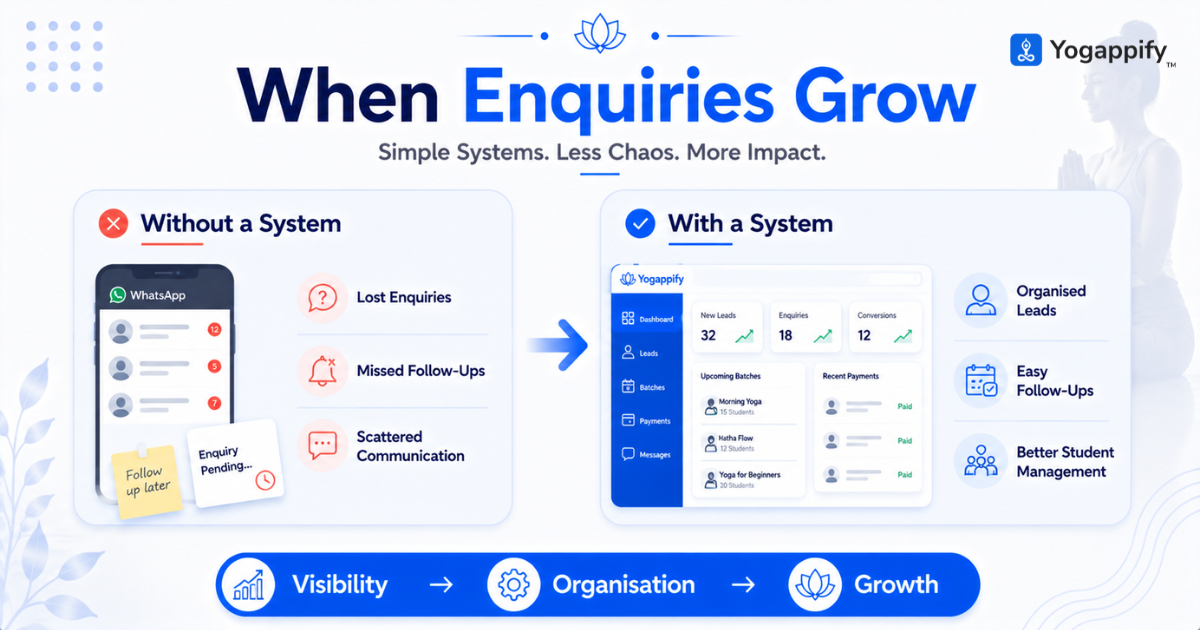
Otherwise, enquiries get lost in WhatsApp. Follow-ups are forgotten. Batch details are repeated manually. Payment reminders become awkward. Student communication becomes scattered.
A simple system can reduce this load.
Yogappify helps yoga teachers create landing pages, manage enquiries, organise batches, track payments, and communicate with students more systematically. You can explore it at yogappify.com.
The purpose of a system is not to make marketing mechanical.
The purpose is to help sincere teachers stay organised after visibility begins working.
Ethical Marketing for Yoga Teachers
Ethical marketing means three things:
- say what is true
- do not exaggerate outcomes
- make it easy for the right person to take the next step
You do not need to make false promises.
You do not need to claim that yoga will solve every problem.
You do not need to create urgency where none exists.
You simply need to communicate honestly and consistently.
Good marketing does not pressure students.
It helps them understand.
It reduces confusion.
It invites the right person gently.
This is also why sales is not convincing; it is clarifying. Marketing helps people discover you. Sales helps interested people understand whether the class is right for them.
Both can be done ethically.
A Simple Weekly Marketing Rhythm
Yoga teachers do not need complicated content calendars in the beginning.
They can begin with a simple weekly rhythm.
For example:
- one post that explains who the class is for
- one post that addresses a common student problem
- one student story or testimonial
- one reminder about batch timing
- one simple invitation to enquire
This rhythm is enough to begin.
The goal is not to post endlessly.
The goal is to make your teaching visible, understandable, and approachable.
Consistency creates recognition.
Recognition creates trust.
Trust creates enquiries.
Frequently Asked Questions
What is marketing for yoga teachers?
Marketing for yoga teachers is the process of making sincere teaching visible and understandable to the right people. It helps potential students know who the teacher serves, what the class offers, how it may help, and how to take the next step.
Is marketing against the spirit of yoga?
No. Marketing is not against yoga when it is done honestly and respectfully. Ethical marketing is service communication. It helps people who may benefit from yoga discover the right teacher.
How can yoga teachers market themselves without feeling salesy?
Yoga teachers can market themselves without feeling salesy by focusing on clarity, education, and invitation instead of pressure. They should explain whom they help, what problem they address, how their class works, and how interested people can enquire.
What should yoga teachers post on social media?
Yoga teachers can post about student problems, class benefits, who the class is for, simple educational tips, student stories, batch details, and gentle invitations to enquire. The content should be clear and consistent rather than random.
Why is visibility important for yoga teachers?
Visibility is important because good teaching cannot help people who do not know the teacher exists. Marketing helps the right students discover, understand, and approach the teacher.
Final Thought
Marketing for yoga teachers is not about becoming loud.
It is about becoming visible.
It is not about selling yourself aggressively.
It is about communicating your service clearly.
A sincere yoga teacher should not remain invisible because marketing feels uncomfortable.
If your work can genuinely help people, it deserves to be understood.
The right people cannot find you if they cannot see you.
And they cannot trust you if they cannot understand you.
So do not think of marketing as self-promotion.
Think of it as making your service visible to the people who may need it.
That is where ethical marketing begins.
Author
Vishal Ganeriwal
Vishal Ganeriwal is an entrepreneur, business strategist, and MSME mentor with nearly three decades of experience in building, managing, and growing businesses. He is part of the founding team and currently Chief Business Officer of Yogappify™, a Success Platform designed to help yoga teachers build more organised, sustainable, and professionally managed businesses. His work brings together practical business strategy, digital marketing, technology, coaching, and grassroots understanding of Indian small businesses. A long-time practitioner and certified trainer of Heartfulness meditation, Vishal believes that business growth should remain rooted in authenticity, service, and human wellbeing. Through his writing, he simplifies marketing, sales, systems, and entrepreneurship for yoga teachers who may not have a formal business background. His perspectives are shaped by lived business experience, continuous experimentation, and close engagement with independent teachers and small yoga studios. He writes to help yoga professionals earn with dignity, work with greater clarity, and create a wider positive impact through their teaching.