


Branding for yoga teachers is not mainly about logos, colours, fonts, or taglines.
Those things matter, but they are not the starting point.
Branding begins with clarity.
Clarity about why you teach. Clarity about how you teach.
Clarity about whom you most want to serve. Clarity about what you want students to remember you for.
When your position is clear, your branding becomes powerful.
When your position is unclear, everything else becomes decoration.
Whether you teach in Bengaluru, Mumbai, London, Sydney, or New York, the challenge is similar.
There are many yoga teachers. Many are sincere. Many are skilled. Many care deeply about their students.
But very few are clearly positioned.
And clarity is what builds trust, recall, referrals, and income over time.
The Biggest Mistake in Branding for Yoga Teachers
When yoga teachers hear the word branding, something often tightens.
It sounds corporate. Commercial. Slightly artificial.
So the conversation quickly moves to safer questions:
- “Maybe I need a better logo.”
- “Should I change my colours?”
- “Do I need a tagline?”
- “Should my Instagram look more professional?”
None of these questions are wrong.
But they are not the heart of branding.
They are packaging.
Last year, I spoke to a yoga teacher who had redesigned her logo three times in one year.
Her Instagram grid was beautiful. Soft colours. Elegant fonts. Thoughtful captions.
But when I asked her one simple question — “Who do you most want to teach?” — she paused.
That pause said more than the logo ever could.
This is where branding for yoga teachers often becomes confusing.
The teacher tries to improve the outer look before clarifying the inner position.
The result is attractive packaging without clear meaning.
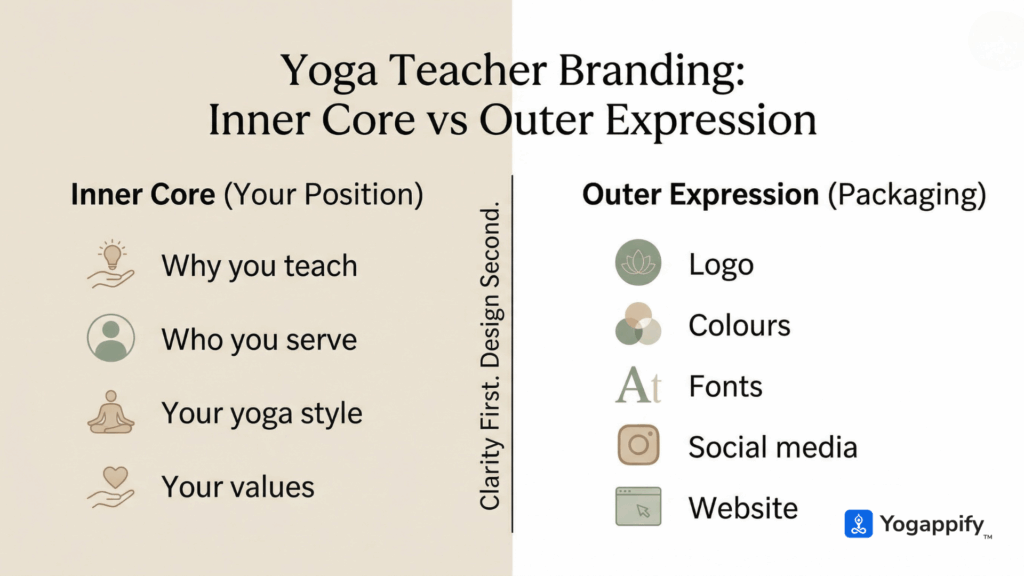
Branding has two important layers:
The Two Layers of Branding for Yoga Teachers
Branding has two important layers:
- the inner core
- the outer expression
The inner core is your position.
The outer expression is your packaging.
If the inner core is unclear, the outer expression becomes decoration.
If the inner core is strong, even simple packaging can feel powerful.
This is why branding should not begin with design.
It should begin with honest questions.
1. The Inner Core: Your Position
Your brand does not begin with colours.
It begins with clarity.
Not only marketing clarity.
Personal clarity.
Before thinking about your logo, sit with these questions:
- Why do I genuinely teach yoga?
- What form of yoga do I prefer to teach, and why?
- What kind of yoga-based solutions do I want to be known for?
- Which type of student do I most want to serve?
- What do I want students to feel after learning with me?
- What kind of transformation am I most suited to support?
These questions are not philosophical luxuries.
They are structural to your branding process.
Because branding is essentially this:
Branding for yoga teachers is the clear position you occupy in the mind of the student who needs you most.
Not everyone.
The right one.
What Do You Really Love About Yoga?
When this clarity develops, branding for yoga teachers becomes a natural extension of your teaching rather than a marketing exercise.
You may love yoga for its healing power.
You may value its preventive-care capability.
You may be drawn to deep focus, discipline, and inner steadiness.
You may care deeply about holistic wellness — Swasthya in its truest sense.
Or you may feel called to make yoga accessible for beginners who feel nervous, stiff, or unsure.
When you can clearly say, “This is what I deeply care about,” something stabilises.
Your communication becomes simpler.
Your content becomes sharper.
Your energy becomes steadier.
Your students begin to sense what you stand for.
If you cannot answer this clearly yet, that is not a logo problem.
It is a clarity problem.
Why Do You Teach?
There is a difference between:
“I completed my YTT.”
And:
“I want others to benefit from yoga in the way I have benefited.”
Students may not always articulate this, but they sense intention.
If your teaching is primarily shaped by pressure, imitation, or the need to look successful, your brand voice will feel different.
If your teaching is shaped by genuine care, lived experience, and quiet conviction, your communication will carry a different quality.
If your understanding of yoga is gentleness and restoration, your brand voice will differ from someone whose understanding is discipline and structure.
Both approaches can be valid.
But their branding will not be the same.
You do not manufacture a brand voice.
It emerges from why you teach.
Why This Style of Yoga?
If you are drawn to Ashtanga, there is a reason.
If you prefer Iyengar, there is a reason.
If you focus on Vinyasa, there is a reason.
If you love classical Hatha sessions, there is a reason.
If you are drawn to breathwork, meditation, therapeutic movement, or beginner-friendly practice, there is also a reason.
When you honour that reason instead of trying to be everything for everyone, your position strengthens.
Your yoga personal brand becomes more defined.
Students begin to recognise you for something specific.
This does not mean you become rigid.
It means you become understandable.
Who Do You Most Want to Serve?
This question often creates fear.
Teachers worry that choosing one audience means excluding others.
It does not.
Choosing a clear audience simply gives direction.
You may feel most energised teaching:
- working mothers juggling family and work
- corporate professionals managing stress
- seniors wanting mobility and balance
- beginners intimidated by advanced studios
- women above 40 restarting movement
- children needing focus and routine
- athletes recovering from stiffness or injury
- people seeking calm, breath, and emotional steadiness
When you define this clearly, three things happen.
Referrals become more precise.
Messaging becomes easier.
Trust builds faster.
This is also where niche clarity for yoga teachers becomes important. A niche is not a limitation. It is a doorway that helps the right students understand why they should come to you.
Clarity reduces friction.
And reduced friction helps students move toward trust.
2. The Outer Expression: Your Packaging
Once your inner position is clear, the outer layer becomes meaningful.
This includes:
- logo
- colours
- fonts
- photography
- tagline
- website tone
- social media voice
- landing page
- posters
- class descriptions
These elements matter.
But they amplify clarity.
They do not create it.
A simple logo with a clear position can work better than a beautiful logo with no clear meaning.
A basic landing page with a clear message can build more trust than a visually polished page that does not explain whom you serve.
Design should support your position.
It should not hide the absence of one.
Logo
Your logo is a symbol.
It should reflect your position, not compensate for its absence.
If your core is strength and structure, your logo may feel precise.
If your core is softness and therapeutic care, your logo may feel gentle.
If your core is energy and movement, your logo may feel more dynamic.
But no logo can fix inner confusion.
Before asking, “Is my logo good enough?”, ask:
“Is my position clear enough?”
Brand Voice
YouYour brand voice is simply how you speak.
Are you calm and minimal?
Analytical and structured?
Warm and nurturing?
Energetic and motivating?
Deep and reflective?
Beginner-friendly and reassuring?
If you imitate what is trending online, inconsistency creeps in.
One day your voice sounds spiritual.
Another day it sounds like a fitness influencer.
Another day it sounds like a corporate wellness page.
Students trust coherence.
They may not analyse it consciously, but they feel it.
Your brand voice should sound like your teaching presence.
Colours and Tagline
Colours and taglines can help, but only when they are rooted in clarity.
A clever tagline without clear positioning may sound attractive, but it may not help students decide.
A simple line like:
“Gentle Yoga for Senior Citizens”
may be more powerful than a poetic but vague tagline.
Similarly:
“Yoga for Busy Professionals”
can build instant alignment because the right person immediately understands the relevance.
Clarity attracts more than cleverness.
Why Branding Directly Affects Income and Growth
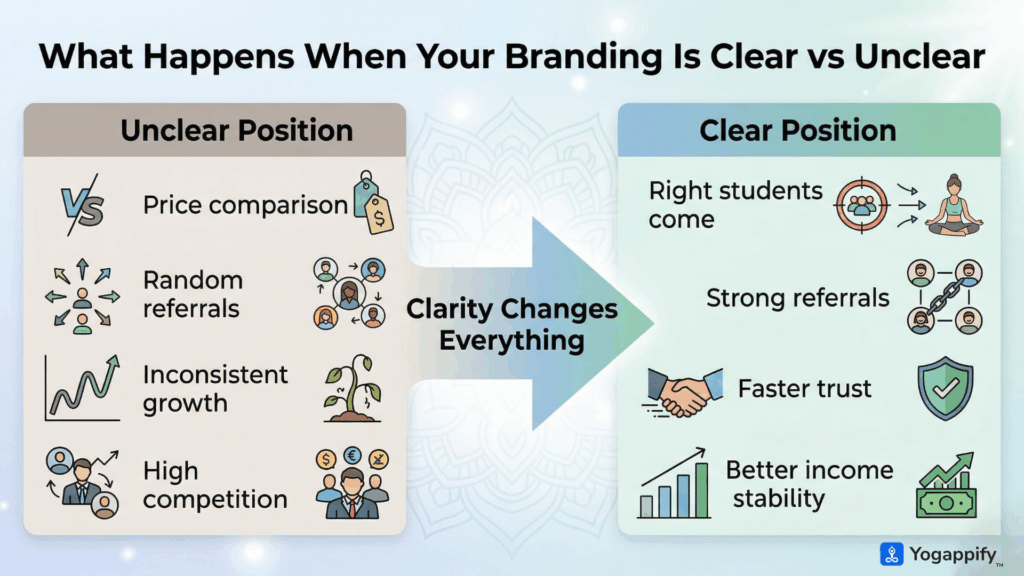
Brand identity for yoga teachers is not only aesthetic.
It directly affects income and growth.
When your position is unclear:
- students compare you mainly on price
- referrals are random
- growth feels inconsistent
- your message keeps changing
- you compete with everyone
When your position is clear:
- students self-select
- referrals become precise
- trust builds faster
- pricing resistance reduces
- your content becomes easier to create
- your marketing becomes more focused
This is why branding and marketing for yoga teachers are connected.
Marketing becomes easier when branding is clear.
If branding answers, “Who am I and whom do I serve?”, marketing answers, “How will the right people discover me?”
Without brand clarity, marketing becomes noise.
With brand clarity, marketing becomes focused visibility.
Branding Also Supports Professional Presence
A clear brand position also strengthens your professional presence as a yoga teacher.
Professional presence does not mean becoming corporate.
It means becoming easier to understand, trust, and approach.
When your position is clear, your class descriptions become clearer. Your landing page becomes clearer. Your social posts become clearer. Your enquiry conversations become clearer.
A student does not have to work hard to understand what you offer.
That itself creates trust.
Branding Can Reduce Pricing Resistance
Clear positioning also affects pricing your yoga classes.
When students do not understand your value, they compare only fees.
But when your position is clear, students are more likely to understand why your class is relevant to them.
For example, “Yoga Class” may sound generic.
But “Gentle Mobility Yoga for Senior Citizens” immediately communicates a specific value.
The clearer the value, the easier it becomes to discuss pricing without discomfort.
Clear positioning reduces negotiation.
Alignment reduces discounting.
Where Simple Systems Can Help
Once your position is clear, you need a simple way to communicate it consistently.
This is where a structured digital presence helps.
A teacher may understand their niche internally, but if every enquiry receives a different explanation, confusion returns.
A simple landing page can act as one source of truth.
It can explain:
- who you help
- what you offer
- class format
- batch timing
- pricing
- testimonials
- how to enquire or join
Yogappify helps yoga teachers present their offering through landing pages, enquiry flows, batch information, and simple student-management systems. You can explore it at yogappify.com.
The goal is not to make branding complicated.
The goal is to make your clarity visible.
A Quiet Reflection
Branding is not self-promotion.
It is responsibility.
It helps the right student find the right teacher.
Before redesigning anything, pause and ask:
- Apart from money, is there a reason I teach yoga?
- What kind of yoga-based solutions do I want to be known for?
- Who do I most want to serve?
- How will they best understand what I want to tell them?
- What should they remember about me after one interaction?
Sit with these questions longer than feels comfortable.
Your position is already forming.
The outer layer can wait.
At its core, branding for yoga teachers is not about visibility alone.
It is about clarity.
Frequently Asked Questions
What is branding for yoga teachers?
Branding for yoga teachers is the clear position a teacher occupies in the mind of the student who needs them most. It is not only visual identity, but clarity about why the teacher teaches, how they teach, and whom they serve.
Is branding only about logo and colours?
No. Logos, colours, fonts, and taglines are part of outer expression. Real branding begins with inner clarity about position, teaching intention, audience, and value.
How do I build a yoga personal brand?
Start by defining why you teach, what form of yoga you prefer, what kind of students you want to serve, and what yoga-based solution you want to be known for. Once this clarity is established, visual elements can support your position.
Does branding affect income for yoga teachers?
Yes. Clear branding can reduce price sensitivity, improve referrals, build trust faster, and help students understand the value of your offering. This can support more stable income over time.
Should new yoga teachers focus on branding?
Yes, but new yoga teachers should begin with positioning, not expensive design. They should first clarify whom they serve, why they teach, and what they want to be known for.
Final Thought
Branding for yoga teachers is not about becoming louder.
It is about becoming clearer.
A logo can help.
Colours can help.
A tagline can help.
But only after you know what you stand for.
When your position is clear, your communication becomes simpler. Your marketing becomes sharper. Your referrals become more precise. Your pricing becomes easier to explain.
And most importantly, the right student finds it easier to recognise you.
That is where real branding begins.
Author
Vishal Ganeriwal
Vishal Ganeriwal is an entrepreneur, business strategist, and MSME mentor with nearly three decades of experience in building, managing, and growing businesses. He is part of the founding team and currently Chief Business Officer of Yogappify™, a Success Platform designed to help yoga teachers build more organised, sustainable, and professionally managed businesses. His work brings together practical business strategy, digital marketing, technology, coaching, and grassroots understanding of Indian small businesses. A long-time practitioner and certified trainer of Heartfulness meditation, Vishal believes that business growth should remain rooted in authenticity, service, and human wellbeing. Through his writing, he simplifies marketing, sales, systems, and entrepreneurship for yoga teachers who may not have a formal business background. His perspectives are shaped by lived business experience, continuous experimentation, and close engagement with independent teachers and small yoga studios. He writes to help yoga professionals earn with dignity, work with greater clarity, and create a wider positive impact through their teaching.