

MKnowledge Matters, But Students Also Experience You
Most yoga teachers naturally focus on improving their knowledge.
They learn better asanas. They improve their class structure. They attend workshops. They gain certifications. They work hard to become better teachers.
All of this matters.
A yoga teacher must continue to grow in knowledge, practice, and teaching ability.
But there is one more success factor that is often overlooked.
It is simple, human, and practical.
It can make a major difference to your growth.
We can call it your Likeability Index.
Your Likeability Index is not about becoming popular in a fake way.
It is not about impressing people, becoming loud, being overly social, or entertaining everyone around you.
It is about how comfortable, respected, and welcome students feel around you.
Students do not experience only your knowledge.
They also experience you.
They experience your warmth, patience, communication, energy, care, interest in them, and the way you make them feel.
This is why likeability matters.
What Is the Likeability Index?
The Likeability Index is the degree to which students feel comfortable, respected, welcome, and connected with a yoga teacher.
It is not about artificial popularity.
It is about the human experience students have while learning from you.
Think about your own life.
We naturally enjoy spending time with people we like.
We trust them more easily.
We look forward to meeting them again.
We feel more open with them.
The same principle applies to yoga classes.
A student may join your class because of your qualification, poster, location, pricing, or recommendation.
But they usually continue because of the overall experience.
Quietly, a student may be asking:
- Do I feel welcome here?
- Does my teacher notice me?
- Do I feel comfortable asking questions?
- Do I feel respected?
- Do I feel encouraged?
- Do I want to come back?
These feelings matter because yoga is not a one-time transaction.
It is a relationship-based journey.
A student may stay with a yoga teacher for months or even years.
That kind of relationship is not built only on technical knowledge.
It is built on trust, comfort, and connection.
Why Likeability Affects Growth
Some teachers may feel that likeability is only a soft quality. But in a yoga business, it Some teachers may feel that likeability is only a soft quality.
But in a yoga business, it has very practical value.
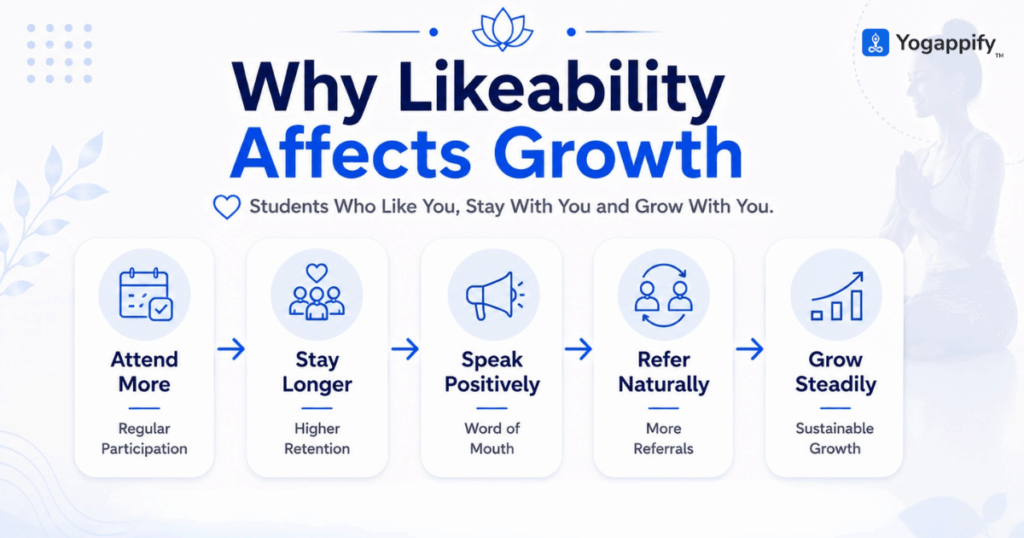
When students enjoy learning from you, they are more likely to:
- attend regularly
- stay longer
- speak positively about you
- recommend you to friends
- invite family members
- return after a break
- become natural ambassadors for your teaching
This directly affects retention, word of mouth, referrals, student confidence, and steady growth.
A student who likes and trusts you does not need to be pushed.
They feel comfortable continuing.
They feel safe asking questions.
They feel happy recommending you.
This is why your Likeability Index is not only a soft skill.
It is also a practical business skill.
In many yoga businesses, growth does not come only from getting new students.
It also comes from keeping the right students happy, supported, and connected for a long time.
Students Experience More Than a Class
A yoga class is not only a sequence of movements.
It is an experience.
A student experiences:
- how you greet them
- whether you remember their name
- whether you notice their struggle
- whether you adjust your tone
- whether you make beginners feel safe
- whether you explain patiently
- whether you encourage without embarrassing
- whether you follow up when someone disappears
- whether you respect their pace
A technically strong class can still feel cold if the student feels unseen.
A simple class can feel deeply valuable if the student feels supported.
This does not mean knowledge is unimportant.
Knowledge is essential.
Without competence, growth cannot be sustained.
But knowledge alone may not be enough for retention.
A student may join because they believe you are capable.
But they continue when they feel connected, supported, and comfortable.
Your knowledge may help a student join your class.
Your human connection often helps that student stay.
And when students stay happily, they naturally tell others about you.
Likeability Does Not Mean Artificial Behaviour
Improving your Likeability Index does not mean becoming someone else.
You do not need to copy another teacher.
You do not need to become louder.
You do not need to force friendliness.
You do not need to act cheerful all the time.
Artificial behaviour does not build trust.
Students can sense when something is not natural.
Likeability grows when your sincere qualities become visible through simple human habits.
The goal is not performance.
The goal is presence.
A quiet teacher can be deeply likeable.
A structured teacher can be deeply likeable.
A serious teacher can be deeply likeable.
A warm teacher can be deeply likeable.
The question is not whether you have a particular personality type.
The question is whether students feel respected, safe, and supported around you.
Likeability does not require showmanship.
It requires attention.
Simple Human Habits Matter
Most of the time, likeability improves through small actions.
For example:
- remember your students’ names
- ask how they are feeling
- notice when someone has been absent
- check if a student is struggling
- listen without rushing
- encourage sincerely
- respond with patience
- follow up gently
- wish students on important occasions
- make people feel seen and respected
None of these require expensive tools.
None of these require advanced marketing.
But they require attention.
And attention is powerful.
A student may forget a perfect instruction.
But they may remember how patiently you helped them when they were struggling.
They may remember that you noticed their absence.
They may remember that you encouraged them when they felt awkward.
They may remember that you did not make them feel small.
These moments build emotional memory.
And emotional memory builds trust.
Likeability and Retention
Many yoga teachers focus mainly on getting new students.
That is understandable.
But growth also depends on retention.
If students join and leave quickly, the teacher must keep finding new people again and again.
This creates pressure.
Retention improves when students feel:
- welcomed
- guided
- encouraged
- understood
- respected
- personally noticed
- comfortable returning after missing a class
A student who misses two classes may feel embarrassed to return.
A gentle message from the teacher can make the return easier.
A beginner who struggles with a posture may feel discouraged.
A kind explanation can help them continue.
A senior student who feels noticed may remain committed longer.
A working professional who feels supported may make yoga part of their routine.
These small relationship moments affect business stability.
This is why likeability is connected to why many yoga teachers struggle financially.
Financial stability is not only about pricing and marketing.
It is also about student retention, trust, and long-term relationships.
Likeability and Referrals
Referrals are not only driven by results.
They are also driven by emotional experience.
A student may refer you because they feel:
- “My teacher is patient.”
- “You will feel comfortable there.”
- “She explains very clearly.”
- “He will not judge you.”
- “Beginners are treated kindly.”
- “You can start even if you are stiff.”
- “The class feels safe.”
- “The teacher really cares.”
These are powerful referral triggers.
People do not refer only technical knowledge.
They refer trust.
They refer comfort.
They refer the feeling that another person will be looked after.
That is why likeability directly supports word of mouth.
And word of mouth is one of the most important growth channels for yoga teachers.
This is also where the Know Me, Like Me, Trust Me journey becomes relevant.
Likeability sits at the heart of the student’s movement from awareness to trust.
A student may know you through marketing.
But they begin moving closer when they like your energy, tone, presence, and communication.
Likeability and Professional Presence
Likeability does not mean informal or careless behaviour.
In fact, likeability becomes stronger when it is supported by professionalism.
A student feels more comfortable when:
- class details are clear
- timing is communicated properly
- payment reminders are respectful
- follow-up is organised
- responses are calm
- joining steps are easy
- expectations are clear
This is why professional presence as a yoga teacher matters.
Professional presence creates clarity.
Likeability creates comfort.
Together, they build trust.
A teacher who is warm but disorganised may create confusion.
A teacher who is organised but cold may create distance.
The ideal balance is simple:
Be clear enough to be trusted.
Be warm enough to be approached.
That combination is powerful.
Likeability and Lead Generation
Lead generation helps new people discover you.
But discovery is only the beginning.
Once someone enquires, your Likeability Index begins to matter.
How do you respond?
Do you sound rushed?
Do you sound patient?
Do you understand what the person needs?
Do you make them feel comfortable asking questions?
Do you follow up gently?
Do you help them feel safe before joining?
This is why lead generation for yoga teachers should not be treated only as a marketing task.
It is also a relationship-building process.
When someone enquires, they are not only evaluating your class.
They are evaluating whether they feel comfortable with you.
Warmth and clarity can convert interest into trust.
Trust can convert enquiry into participation.
Participation can convert into retention.
And retention can convert into referrals.
This is how human connection supports growth.
Likeability and Ethical Sales
A likeable teacher does not need to manipulate students.
When students feel respected, sales conversations become easier.
They are more willing to ask questions.
They are more willing to share hesitation.
They are more willing to listen.
They are more likely to trust the teacher’s explanation.
This does not mean every student will join.
But it means the conversation becomes healthier.
Ethical sales is not about pushing.
It is about helping the student decide clearly.
When your communication is warm and respectful, sales is not convincing; it is clarifying.
Likeability supports this process because the student feels safe enough to be honest.
They may say:
“I am worried I will not be able to continue.”
“I am not sure if I can afford this.”
“I feel too stiff.”
“I am nervous about joining a group.”
A teacher who listens well can guide better.
A teacher who makes people feel judged may lose the opportunity to help.
Likeability and the 10 in 10 Challenge
At Yogappify, the 10 in 10 Challenge is designed to help yoga teachers grow in a structured way.
The idea is simple.
Once a teacher completes the basic business setup inside Yogappify, they become ready to work towards getting 10 students.
But growth does not come only from digital tools.
It also does not come only from marketing tactics.
Growth happens when tools, communication, teaching quality, and human connection start working together.
That is why soft-skills learning is also important.
A yoga teacher who wants to grow must learn how to:
- communicate clearly
- follow up gently
- create trust
- make students feel welcome
- support students consistently
- retain students patiently
These are not separate from business growth.
They are part of business growth.
Getting 10 students is important.
But helping those students stay, grow, and refer others is equally important.
Where Yogappify Can Support This Journey
Yogappify is designed as a success platform for yoga teachers.
It brings together easy-to-use digital tools, practical success resources, business coaching, community support, and structured learning journeys.
The app can help you manage your:
- landing page
- enquiries
- batches
- students
- communication
- payments
- follow-up
You can explore Yogappify at yogappify.com.
But the teacher still remains the heart of the journey.
Tools can support structure.
But your warmth builds connection.
Tools can help you stay organised.
But your sincerity builds trust.
Tools can make your work smoother.
But your presence makes students stay.
This balance is important.
A system can remind you to follow up.
But the care in the follow-up must come from you.
A landing page can explain your offer.
But the comfort students feel must come from your communication.
A batch system can organise students.
But the relationship is built by your presence.
A Simple Likeability Reflection for Yoga Teachers
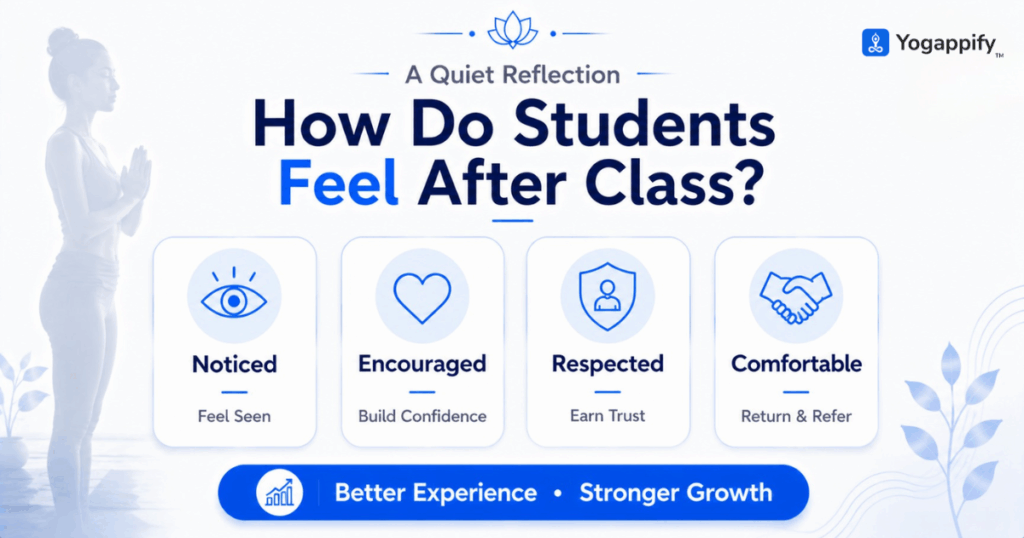
If your students attend your class, how do they feel when they leave?
Ask yourself:
- Do they feel noticed?
- Do they feel encouraged?
- Do they feel respected?
- Do they feel comfortable coming back?
- Do they feel safe asking questions?
- Do beginners feel welcomed?
- Do absent students feel invited back without guilt?
- Do students feel confident recommending me?
- Do I listen patiently?
- Do I make students feel seen?
These are not small questions.
They directly affect the future of your yoga practice.
A student may not remember every instruction.
But they will remember how they felt in your presence.
Frequently Asked Questions
What is the Likeability Index for yoga teachers?
The Likeability Index is the degree to which students feel comfortable, respected, welcome, and connected with a yoga teacher. It is not about artificial popularity. It is about the human experience students have while learning from you.
Why is likeability important for yoga teachers?
Likeability is important because yoga is a relationship-based journey. When students feel comfortable and respected, they are more likely to attend regularly, stay longer, refer others, and speak positively about the teacher.
Does likeability mean I need to become more social or outgoing?
No. Likeability does not mean becoming loud, overly social, or artificial. It means expressing sincere qualities through simple habits such as listening carefully, remembering names, encouraging students, and making people feel welcome.
How can yoga teachers improve student retention?
Yoga teachers can improve retention by combining good teaching with human connection. Simple actions like noticing absences, following up gently, encouraging students, and creating a warm class experience help students feel supported and continue longer.
How does Yogappify support yoga teachers in this journey?
Yogappify supports yoga teachers with digital tools, practical success resources, business coaching, community support, and structured learning journeys. These systems help teachers stay organised while they focus on building trust, connection, and student growth.
Final Thought
Your growth as a yoga teacher does not come only from doing more marketing.
It also comes from becoming more useful, more attentive, more thoughtful, and more caring.
Build your knowledge.
Build your competence.
But also build your Likeability Index.
Be sincere.
Be warm.
Be service-minded.
Because people like to be around people they like.
A student remembers how you made them feel more than what you told them.
And when students feel happy, respected, and supported, your yoga practice grows naturally.
Author
Vishal Ganeriwal
Vishal Ganeriwal is an entrepreneur, business strategist, and MSME mentor with nearly three decades of experience in building, managing, and growing businesses. He is part of the founding team and currently Chief Business Officer of Yogappify™, a Success Platform designed to help yoga teachers build more organised, sustainable, and professionally managed businesses. His work brings together practical business strategy, digital marketing, technology, coaching, and grassroots understanding of Indian small businesses. A long-time practitioner and certified trainer of Heartfulness meditation, Vishal believes that business growth should remain rooted in authenticity, service, and human wellbeing. Through his writing, he simplifies marketing, sales, systems, and entrepreneurship for yoga teachers who may not have a formal business background. His perspectives are shaped by lived business experience, continuous experimentation, and close engagement with independent teachers and small yoga studios. He writes to help yoga professionals earn with dignity, work with greater clarity, and create a wider positive impact through their teaching.