


What Determines the Right Price?
One of the most common questions new yoga teachers ask is:
“How much should I charge for my yoga classes?”
Should it be ₹500, ₹1,000, ₹2,000, or more?
The honest answer is this:
There is no single correct price.
The right price depends on your context. It depends on what you are offering, whom you are teaching, how often you are teaching, how much personal attention you provide, and the value the student receives.
Pricing your yoga classes becomes much easier when you evaluate these factors thoughtfully.
Pricing is not a random number.
It is a thoughtful decision.
Good Pricing Respects Both Sides
Before deciding your fee, understand one important principle.
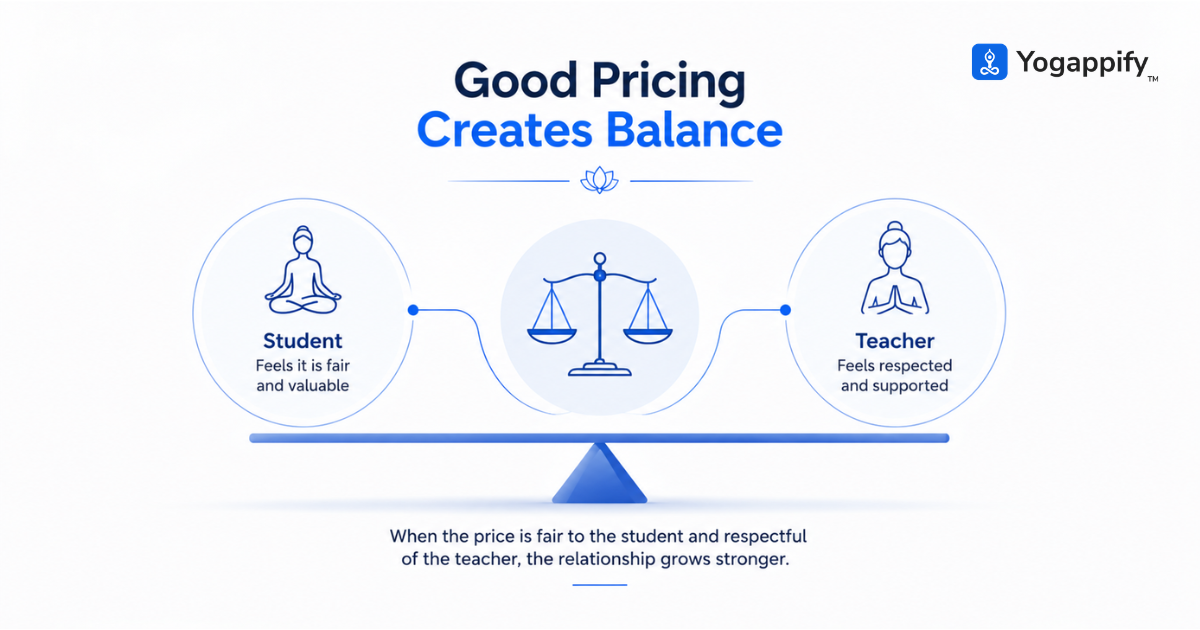
Your price should respect two people.
The first is your student.
The fee should feel reasonable and fair for the experience you are offering.
The second is you.
Your price should also respect your preparation, time, effort, learning, and the energy you bring to your class.
If you charge too little only because you are afraid people may say no, your practice may become difficult to sustain. You may start feeling tired, undervalued, or financially pressured.
If you charge too much before your value and trust are clearly visible, people may hesitate to join.
Good pricing creates balance.
It is fair to the student and respectful of the teacher.
Remember, pricing your yoga classes is always contextual. The same fee can feel expensive, fair, or even affordable depending on the type of student, the market you serve, and how clearly you position the value of your offering.
Factor 1: Class Format
The first factor that affects pricing is the format of the class.
An online group class is different from an offline class.
A small-group session is different from a large batch.
A one-to-one class is different from a group class.
A home visit is different from teaching at your own location.
Why?
Because the level of personal attention, convenience, travel, and effort changes.
In general, larger groups may allow more accessible pricing. Smaller groups may justify a higher fee because the teacher can give more attention. One-to-one sessions usually cost more because the guidance is more personalised. Home visits may include a convenience and travel premium.
So before comparing your price with another teacher, compare the format properly.
Two yoga classes may look similar from outside, but the effort and value experience may be very different.
Factor 2: Frequency and Duration
The second factor is frequency.
How many sessions are included in the fee?
For example:
- 8 sessions per month
- 12 sessions per month
- 20 sessions per month
- unlimited access
Duration also matters.
A 45-minute class and a 75-minute class are not the same. A twice-a-week class and a five-days-a-week class cannot be compared only by looking at the monthly fee.
This is where many teachers and students make a mistake.
They compare only the number.
But pricing your yoga classes should be tied to your overall offering.
So always ask:
“What exactly is included in the price?”
Factor 3: Batch Size
Batch size also affects value.
A class with 25 students is different from a class with 6 students.
In a smaller batch, the teacher may be able to offer closer observation, more personal guidance, suitable modifications, stronger interaction, and better follow-up.
That added attention creates additional value.
This does not mean large batches are bad.
Large batches can be useful, energetic, and more affordable for students.
But the pricing logic is different.
Larger groups usually support more accessible pricing. Smaller groups can justify a higher fee. One-to-one sessions usually sit at a premium level because the guidance is fully personalised.
Factor 4: Your Audience and Market Context
Your audience matters.
A class for working professionals may be priced differently from a community batch.
A class in a premium apartment complex may be priced differently from a neighbourhood batch in a price-sensitive locality.
An online class serving students across India may work differently from a local offline class.
Your city matters.
Your locality matters.
Your audience matters.
But here is the important warning:
Do not blindly copy another teacher’s price.
Their context may be different from yours. Their students may be different. Their format may be different. Their batch size, positioning, experience, and trust level may also be different.
Pricing should be aware of the market, but not controlled by blind comparison.
This is one reason why many yoga teachers struggle financially. They either underprice themselves out of fear or copy someone else’s price without understanding the structure behind it.
Factor 5: Your Positioning
Positioning has a strong effect on how students understand your value.
A general yoga batch and a niche-led batch may not be perceived in the same way.
Compare these two lines:
“Morning Yoga Class”
and
“Gentle Mobility Yoga for Senior Citizens”
Or compare:
“Yoga Class for Beginners”
with
“Beginner Yoga for Women Above 40”
The niche-led class feels more relevant to the right person. It helps the student immediately understand whether the class is for them.
At Yogappify, we treat a niche as a doorway.
It helps people discover you, understand you, and remember you.
But it does not limit your practice.
You may still run general yoga batches too. Over time, if your expertise deepens, your niche may also create premium opportunities.
This is why niche clarity for yoga teachers matters. Clear positioning helps students understand value before they compare fees.
Factor 6: Your Experience and Expertise
Your value may grow through many things:
- teaching experience
- student outcomes
- testimonials
- certifications
- deeper learning
- communication ability
- safe teaching practices
- stronger understanding of your niche
But remember this clearly:
Certifications alone do not automatically justify a higher fee.
Premium pricing must be earned.
It grows through competence, trust, and real student value.
A student is not only paying for your certificate. They are paying for the confidence that you can guide them safely, clearly, and meaningfully.
So keep learning.
Keep practising.
Keep serving.
Keep improving.
Then allow your pricing to evolve with your value.
Factor 7: Depth of Service
Two teachers may conduct the same number of classes.
But the student experience may still be very different.
One teacher may offer only the class.
Another may also offer:
- simple onboarding
- progress tracking
- suitable modifications
- regular follow-up
- workshops
- educational resources
- community support
The student is not paying only for a class.
The student is paying for the overall experience.
When your value is clear, sales is not convincing; it is clarifying.
This is where many yoga teachers underestimate their own work. If you are providing more support, better communication, structured follow-up, and a smoother student journey, that has value.
These elements also strengthen your professional presence as a yoga teacher.
A deeper service experience can support stronger pricing, provided the student can clearly understand that value.
Factor 8: Your Cost and Sustainability
Your own cost also matters.
You may have costs such as:
- venue rent
- travel
- online tools
- equipment
- preparation time
- follow-up time
- marketing effort
A price that looks attractive but creates exhaustion or financial loss cannot support a healthy practice for long.
Sustainability matters.
If your price does not respect your effort, your quality may slowly suffer. You may begin with enthusiasm, but over time the pressure can build.
A yoga practice should support the student.
But it should also support the teacher.
Good pricing is not only about what the market will accept.
It is also about what will allow you to keep teaching with steadiness, care, and consistency.
Factor 9: Demand and Trust
Your first price is not your final price.
A new teacher with empty batches may begin differently from a teacher who already has strong testimonials, regular referrals, full batches, waiting lists, and deeper niche expertise.
As trust grows, pricing your yoga classes can evolve.
As student outcomes become visible, pricing can evolve.
As demand grows, pricing can evolve.
This is important for new teachers to understand.
You do not need to get your pricing perfect on day one. You need to choose a sensible starting point and keep reviewing it as your value, confidence, and demand grow.
Do not underprice because of fear.
Do not overprice before trust has caught up with your promise.
Choose a price that is fair, confident, and sustainable.
For some new teachers, it may also help to clearly mention the standard fee and then offer a limited introductory fee for early joiners. This keeps the value of your regular pricing visible while giving new students an easier starting point. Later, as trust and demand grow, you can move closer to your standard fee.
Where Simple Systems Can Help
Pricing is not only about deciding a fee.
It is also about presenting that fee clearly, collecting payments smoothly, and reducing awkwardness around reminders.
Many yoga teachers feel uncomfortable when payment conversations become scattered across WhatsApp messages, verbal reminders, and manual tracking.
A simple system can make the experience clearer for both teacher and student.
Yogappify helps yoga teachers present their batches, manage pricing information, track payments, send reminders, and organise student communication in one structured flow. You can explore it at yogappify.com.
The purpose of a system is not to make yoga teaching transactional.
The purpose is to make the business side calmer, clearer, and easier to manage.
When payment and batch information are organised, the teacher can focus more fully on teaching.
A Simple Pricing Reflection for Yoga Teachers
Before finalising your fee, ask:
- What format am I offering?
- How many sessions are included?
- How long is each session?
- How many students are in the batch?
- Who is my audience?
- What is the market context?
- What is my positioning?
- What level of experience and trust do I bring?
- What depth of service am I offering beyond the class?
- What costs do I need to recover?
- Is this price sustainable for me?
- Does this price feel fair to the student?
- Is the value clear enough?
These questions will not give one universal answer.
But they will help you arrive at a better answer for your own context.
Frequently Asked Questions
What is the right price for yoga classes?
There is no single right price for yoga classes. The right fee depends on the class format, frequency, duration, batch size, audience, location, positioning, teacher experience, depth of service, cost, demand, and trust.
Why should yoga teachers avoid copying another teacher’s price?
Yoga teachers should avoid blindly copying another teacher’s price because every teacher has a different format, audience, locality, batch size, experience level, positioning, and value experience.
Can a new yoga teacher charge premium fees?
A new yoga teacher should be careful with premium pricing. Higher fees become easier to justify when trust, student outcomes, testimonials, competence, and clear value are visible.
How does batch size affect yoga class pricing?
Batch size affects pricing because smaller batches usually allow more personal attention, closer observation, modifications, and interaction. Larger batches may support more accessible pricing, while one-to-one sessions usually justify premium pricing.
Why is sustainability important in yoga pricing?
Sustainability is important because a price that is too low may create exhaustion, financial pressure, or poor consistency for the teacher. A healthy yoga practice should be fair to the student and also respectful of the teacher’s effort.
Final Thought
Pricing your yoga classes is not only about money.
It is also about clarity.
It is about respecting your student.
It is about respecting your own effort.
And it is about building a yoga practice that can grow steadily over time.
Start thoughtfully.
Keep improving.
Allow your pricing to evolve as your value grows.
Good pricing respects the student, the teacher, and the journey.
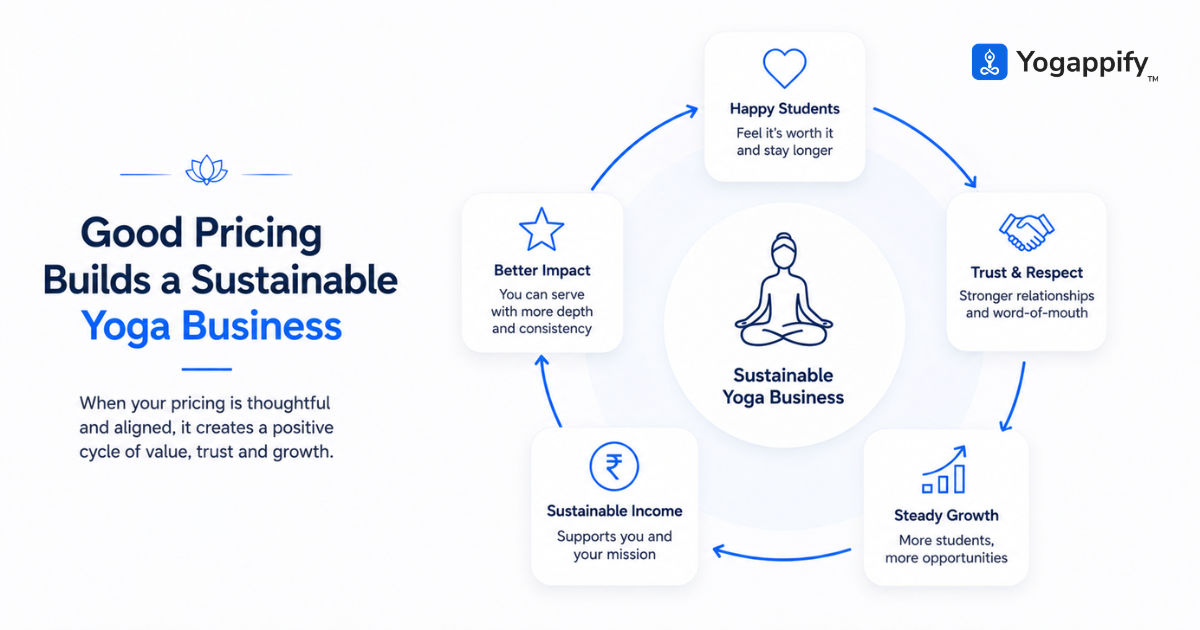
Ultimately, pricing your yoga classes is about balancing value, trust, and long-term sustainability.
Author
Vishal Ganeriwal
Vishal Ganeriwal is an entrepreneur, business strategist, and MSME mentor with nearly three decades of experience in building, managing, and growing businesses. He is part of the founding team and currently Chief Business Officer of Yogappify™, a Success Platform designed to help yoga teachers build more organised, sustainable, and professionally managed businesses. His work brings together practical business strategy, digital marketing, technology, coaching, and grassroots understanding of Indian small businesses. A long-time practitioner and certified trainer of Heartfulness meditation, Vishal believes that business growth should remain rooted in authenticity, service, and human wellbeing. Through his writing, he simplifies marketing, sales, systems, and entrepreneurship for yoga teachers who may not have a formal business background. His perspectives are shaped by lived business experience, continuous experimentation, and close engagement with independent teachers and small yoga studios. He writes to help yoga professionals earn with dignity, work with greater clarity, and create a wider positive impact through their teaching.