


Selling Feels Uncomfortable for Many Yoga Teachers
For many yoga teachers, selling feels uncomfortable.
Even the word “selling” creates resistance.
It immediately brings to mind images of:
- pressure
- manipulation
- aggressive persuasion
- fake urgency
- commercial behaviour
Because of this, many sincere yoga teachers avoid sales completely.
They hope that if they simply teach well, students will naturally come.
Sometimes this does happen.
But in today’s world, this approach alone is usually not enough.
A yoga teacher may be sincere, skilled, and deeply committed. But if people do not know about the teacher, understand the offering, or feel guided toward the next step, the classes may still remain empty.
This is the misunderstanding that needs to be corrected.
Selling yoga is not wrong when the intention is honest, the communication is clear, and the offer genuinely fits the student’s need.
The problem is not selling.
The problem is manipulation.
Why Many Yoga Teachers Hesitate to Sell
Most yoga teachers enter this field because they genuinely want to help people.
They care about:
- wellbeing
- healing
- balance
- meaningful work
- inner growth
- service
Because of this, they often feel uncomfortable “promoting” themselves.
Some even feel that asking someone to pay for yoga somehow reduces the purity of yoga.
This hesitation is understandable.
A sincere teacher does not want to appear pushy. A sincere teacher does not want to make yoga feel like a commodity. A sincere teacher does not want students to feel pressured.
But this hesitation creates a serious practical problem.
Many good yoga teachers remain invisible.
Not because they lack capability.
But because they hesitate to communicate their value clearly and confidently.
This is why marketing for yoga teachers and ethical sales must be understood properly. Marketing makes your sincere work visible. Sales helps interested people decide whether your offering is right for them.
Both can be done with care.
Both can be done without pressure.
The Real Problem Is Not Selling
The real problem is how society often experiences selling.
Most people have experienced bad sales behaviour at some point.
Things like:
- unnecessary pressure
- fake urgency
- exaggerated promises
- emotional manipulation
- hiding important information
- pushing something unsuitable
Naturally, this creates resistance.
So when yoga teachers hear the word “sales,” they imagine this kind of behaviour.
But ethical sales is very different from manipulative sales.
This distinction is extremely important.
Manipulation means pushing the wrong solution for your own benefit.
Ethical sales means helping the right person understand whether your offering genuinely fits their need.
Manipulation creates pressure.
Ethical sales creates clarity.
Manipulation prioritises money over fit.
Ethical sales protects both student and teacher.
Ethical Sales and Manipulation Are Not the Same Thing
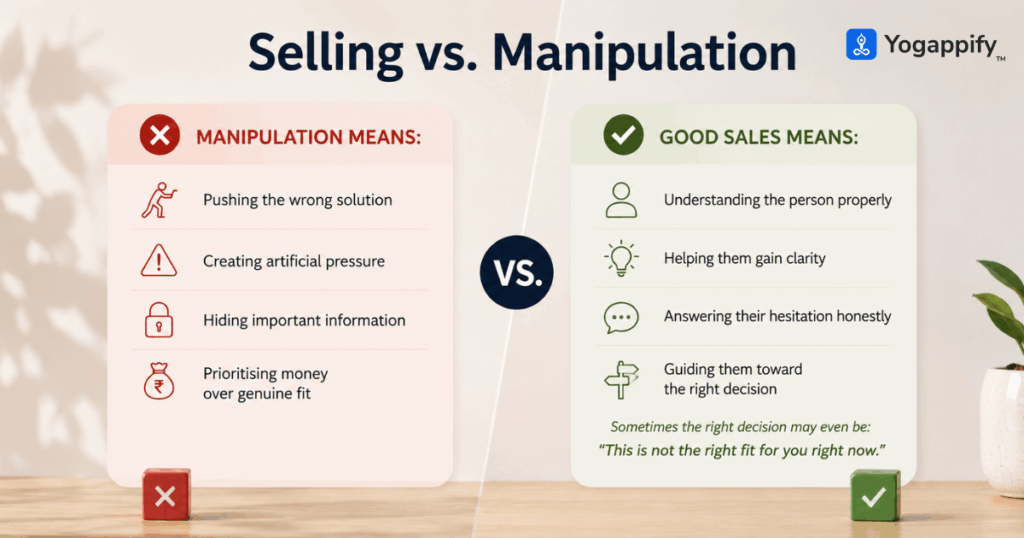
Manipulation means:
- pushing the wrong solution
- creating artificial pressure
- hiding important information
- exaggerating outcomes
- prioritising money over genuine fit
Good sales is the opposite.
Good sales means:
- understanding the person properly
- listening to their need
- answering hesitation honestly
- helping them gain clarity
- guiding them toward the right decision
Sometimes the right decision may even be:
“This is not the right fit for you right now.”
That is also ethical selling.
There is an old sales interview question: “How will you sell a comb to a bald man?”
In ethical selling, that question itself is wrong.
You do not sell something to someone who does not need it.
A yoga teacher should never push a class, program, or package onto someone for whom it is not suitable.
That is not service.
That is not yoga.
But when your class can genuinely help someone, communicating it clearly is not manipulation.
It is responsibility.
If Yoga Genuinely Helps People, Then Why Hesitate?
This is an important question every yoga teacher should reflect on.
If you genuinely believe that yoga can help people:
- build a regular wellness habit
- reduce everyday stress
- improve flexibility and mobility
- feel more balanced
- develop greater body awareness
- create more steadiness in life
then why should helping people discover your classes feel wrong?
The intention matters.
If your intent is only to extract money, students will eventually feel it.
But if your intent is genuinely to help, then communicating your offering clearly is not wrong.
It is part of service.
There may be someone who needs exactly the kind of yoga you teach.
But they may not know you exist.
They may not know your class is beginner-friendly.
They may not know you offer gentle guidance.
They may not know your batch timing.
They may not know whether they can speak to you before joining.
If you do not communicate, they may never come closer.
So the question is not:
“Should I sell?”
The better question is:
“How can I communicate my offering honestly, clearly, and responsibly?”
Many Students Need Guidance Before They Join
Another misunderstanding many yoga teachers have is this:
“If someone is interested, they will automatically join.”
In reality, this is rarely how human behaviour works.
Many people hesitate even when they know something may help them.
They may think:
- “I’ll start later.”
- “I am not flexible enough.”
- “I do not know if yoga is for me.”
- “I may not be able to continue regularly.”
- “What if I feel uncomfortable?”
- “Will I be judged?”
- “Is this class suitable for my age or current level?”
These hesitations are natural.

A calm conversation, proper explanation, or gentle follow-up often helps people move A calm conversation, proper explanation, or gentle follow-up can help people move forward.
This is not pressure.
This is guidance.
Sometimes one thoughtful conversation changes everything.
Not because the teacher “convinced” the student.
But because the teacher helped the student feel safe enough to begin.
This is why sales is not convincing; it is clarifying.
A student does not always need persuasion.
Often, they need reassurance, clarity, and a simple next step.
Good Teaching Alone Does Not Create Visibility
This is another difficult truth many teachers eventually realise.
Being good at teaching and being visible are two different things.
A teacher may be excellent, sincere, and deeply knowledgeable.
But if people do not hear about the class, the teaching remains hidden.
If students do not understand the offering, they may not enquire.
If the next step is unclear, interest may disappear.
If the teacher never follows up, hesitation may remain unresolved.
This is why good teaching needs clear communication.
Visibility does not reduce the purity of yoga.
Visibility allows the right students to find the right teacher.
This is also where lead generation for yoga teachers becomes important. Lead generation is not chasing people. It is creating opportunities for interested people to discover you and begin a conversation.
When done ethically, lead generation and sales work together.
Lead generation opens the door.
Sales helps the person decide whether to enter.
Selling Begins With Listening
Many people think sales means talking well.
Actually, good sales often begins with listening well.
Before suggesting a class or offer, a teacher should understand:
- Why is this person exploring yoga?
- What are they struggling with?
- What are they hoping to improve?
- What hesitation are they carrying?
- What kind of class would feel comfortable?
- What timing, format, or level may suit them?
Without understanding the student properly, even sincere guidance can become ineffective.
Listening prevents wrong selling.
Listening protects the student.
Listening also helps the teacher speak with more relevance.
Instead of saying:
“You should join this class.”
A teacher can say:
“Based on what you shared, this beginner-friendly batch may be suitable because it starts slowly and focuses on regularity.”
The tone changes.
The intention changes.
The student feels respected.
That is ethical sales.
Follow-Up Is Not Always Pushy
Many yoga teachers avoid follow-up because they fear sounding commercial.
They think:
“If the person is interested, they will come back.”
Sometimes they do.
Often, they do not.
Not because they are uninterested.
But because life is busy.
People delay many good decisions:
- exercise
- meditation
- therapy
- sleep improvement
- healthier routines
- yoga
Not because these things lack value.
But because human beings hesitate, postpone, overthink, and get distracted.
A gentle follow-up often helps people move through this emotional resistance.
For example:
“Namaste. Just checking if you had a chance to think about the beginner batch we discussed. If you have any questions about timing, suitability, or fees, I will be happy to clarify.”
This is not pressure.
This is support.
A good follow-up should be:
- respectful
- specific
- useful
- not too frequent
- easy to respond to
- free from pressure
At least two or three gentle follow-ups at proper intervals are reasonable unless the person clearly says they are not interested.
And if someone is hesitating, try to understand the obstacle.
If price is a barrier, you may offer a beginner option.
If confidence is low, you may invite them to a trial session.
If reassurance is needed, you may share a student story.
If timing is difficult, you may suggest another batch.
This is not chasing.
This is guidance.
Selling Without Guilt Requires Clear Pricing
Guilt around selling often becomes stronger when pricing is unclear.
A teacher may feel awkward saying the fee.
They may lower the price too quickly.
They may apologise before the student even reacts.
They may assume that the student will think it is too expensive.
But if your pricing is thoughtful, fair, and connected to the value you provide, you do not need to apologise for it.
This is why pricing your yoga classes becomes an important part of ethical sales.
Good pricing respects both sides.
It respects the student’s ability to understand value.
It also respects the teacher’s time, effort, learning, preparation, and sustainability.
Charging for sincere work is not wrong.
Charging without clarity, honesty, or value is the problem.
When your price is fair and your communication is clear, selling becomes calmer.
Professional Presence Helps Reduce Sales Discomfort
Sales becomes harder when everything is scattered.
If your class details are unclear, you must explain everything repeatedly.
If your pricing is unclear, every conversation feels awkward.
If your batch information is scattered across WhatsApp messages, the student may feel unsure.
If your follow-up depends only on memory, interested people may get lost.
A clear professional presence as a yoga teacher reduces this confusion.
Simple things help:
- a clear class description
- structured batch information
- easy enquiry process
- clear pricing
- simple onboarding
- organised follow-up
- smooth payment communication
When information is organised, students naturally feel more confident.
And when students feel confident, the teacher does not need to push.
The structure itself creates clarity.
Where Simple Systems Can Help
A teacher does not need complex technology to sell ethically.
But as enquiries grow, simple systems help.
You may need a way to:
- present your class clearly
- collect enquiries
- track interested students
- remember follow-ups
- share batch details
- communicate pricing
- manage payments
- send reminders
- onboard students smoothly
Yogappify helps yoga teachers manage landing pages, enquiries, batches, payments, reminders, and student communication in one structured flow. You can explore it at yogappify.com.
The purpose of a system is not to make yoga teaching commercial.
The purpose is to reduce confusion.
When clarity improves, hesitation often reduces naturally.
And when hesitation reduces, good decisions become easier.
A Simple Ethical Sales Reflection for Yoga Teachers
Before your next sales conversation, ask yourself:
- Am I trying to pressure or guide?
- Have I understood the student’s real need?
- Is my class genuinely suitable for this person?
- Have I explained the offer clearly?
- Have I communicated the fee without guilt?
- Have I answered doubts honestly?
- Have I made the next step easy?
- Have I followed up respectfully?
- Am I willing to say “not right now” if the fit is not right?
These questions protect your integrity.
They also protect the student.
Ethical sales does not ask you to become someone else.
It asks you to communicate your genuine value clearly and responsibly.

Frequently Asked Questions
Is selling yoga wrong?
No. Selling yoga is not wrong when your intention is genuinely to help people and your communication is honest. Ethical selling helps people discover and access an offering that may genuinely support them.
Why do many yoga teachers feel uncomfortable selling?
Many yoga teachers associate sales with pressure, manipulation, exaggerated promises, or overly commercial behaviour. This makes them hesitant, even when their offering is sincere and useful.
What is ethical sales in yoga?
Ethical sales in yoga means helping the right person gain clarity about whether your offering genuinely fits their needs. It involves listening, explaining honestly, answering doubts, and guiding without pressure.
Is follow-up considered pushy?
Not necessarily. Gentle and respectful follow-up often helps students who are hesitant, distracted, or unsure. Follow-up becomes pushy only when it creates pressure, ignores boundaries, or does not respect the student’s choice.
How can yoga teachers improve sales without sounding commercial?
Yoga teachers can improve sales by communicating clearly, listening carefully, building trust, explaining suitability, sharing pricing confidently, and focusing on genuine student needs instead of pressure tactics.
Final Thought
If your offering genuinely helps people, then helping them make a decision is not manipulation.
The world does not need more aggressive selling.
But it does need more sincere people who are willing to communicate clearly, confidently, and responsibly.
Yoga teachers do not need to sell with pressure.
They need to guide with clarity.
They do not need to manipulate.
They need to listen.
They do not need to feel guilty about charging.
They need to build a sustainable teaching life.
And perhaps that is where good yoga teachers need to step forward.
Not loudly.
Not aggressively.
But honestly.
Clearly.
And with responsibility.
Author
Vishal Ganeriwal
Vishal Ganeriwal is an entrepreneur, business strategist, and MSME mentor with nearly three decades of experience in building, managing, and growing businesses. He is part of the founding team and currently Chief Business Officer of Yogappify™, a Success Platform designed to help yoga teachers build more organised, sustainable, and professionally managed businesses. His work brings together practical business strategy, digital marketing, technology, coaching, and grassroots understanding of Indian small businesses. A long-time practitioner and certified trainer of Heartfulness meditation, Vishal believes that business growth should remain rooted in authenticity, service, and human wellbeing. Through his writing, he simplifies marketing, sales, systems, and entrepreneurship for yoga teachers who may not have a formal business background. His perspectives are shaped by lived business experience, continuous experimentation, and close engagement with independent teachers and small yoga studios. He writes to help yoga professionals earn with dignity, work with greater clarity, and create a wider positive impact through their teaching.