


It is not the same as complexity
For many yoga teachers, the idea of being “professional” feels uncomfortable.
It can sound too formal. Too corporate. Too polished. Almost as if the teacher has to become someone else before students will take them seriously.
But professional presence for yoga teachers does not mean becoming corporate.
It means becoming clear.
It means helping students understand what you offer, how your classes work, how they can join, and what kind of experience they can expect.
A sincere and skilled yoga teacher may teach beautifully. But in today’s world, teaching quality alone is not always enough.
Students are also looking for:
- clarity
- reliability
- trust
- consistency
- confidence before taking the next step
That is exactly what professional presence helps create.
Professional presence helps students feel confident about choosing your classes even before they meet you in person.
What Does “Professional Presence” Really Mean?

Professional presence for yoga teachers is the way you present your offering, communicate your value, and guide a student from interest to participation with clarity and consistency.
It is not about:
- looking picture-perfect
- being overly formal
- creating a flashy identity
- spending heavily on design
- copying corporate communication
Instead, it is about being:
- clear in what you offer
- consistent in how you communicate
- dependable in how you respond
- organised in how you guide students
- thoughtful in how you manage the student experience
Professional presence helps students understand, trust, and engage with your yoga offerings more easily.
It begins with simple communication.
It grows through consistent structure.
And over time, it becomes one of the foundations of sustainable growth.
Why This Matters More Than Most Yoga Teachers Realize
MMany yoga teachers believe:
“If I teach well, students will naturally come.”
Teaching quality absolutely matters.
But visibility and trust do not happen automatically.
A student may hear about you from a friend. They may see your Instagram profile. They may receive your WhatsApp poster. They may visit your landing page. They may call you to ask about a batch.
At each of these moments, they are silently asking:
- Is this teacher clear?
- Is this class suitable for me?
- Do I know what to do next?
- Does this feel organised?
- Can I trust this person with my time, body, and learning?
Before the first class begins, your professional presence has already started speaking.
If the information is confusing, trust reduces.
If the response is delayed, confidence reduces.
If pricing is unclear, hesitation increases.
If the next step is not obvious, interest may disappear.
This is why professional presence is not a cosmetic issue.
It directly affects enquiries, conversions, retention, and referrals.
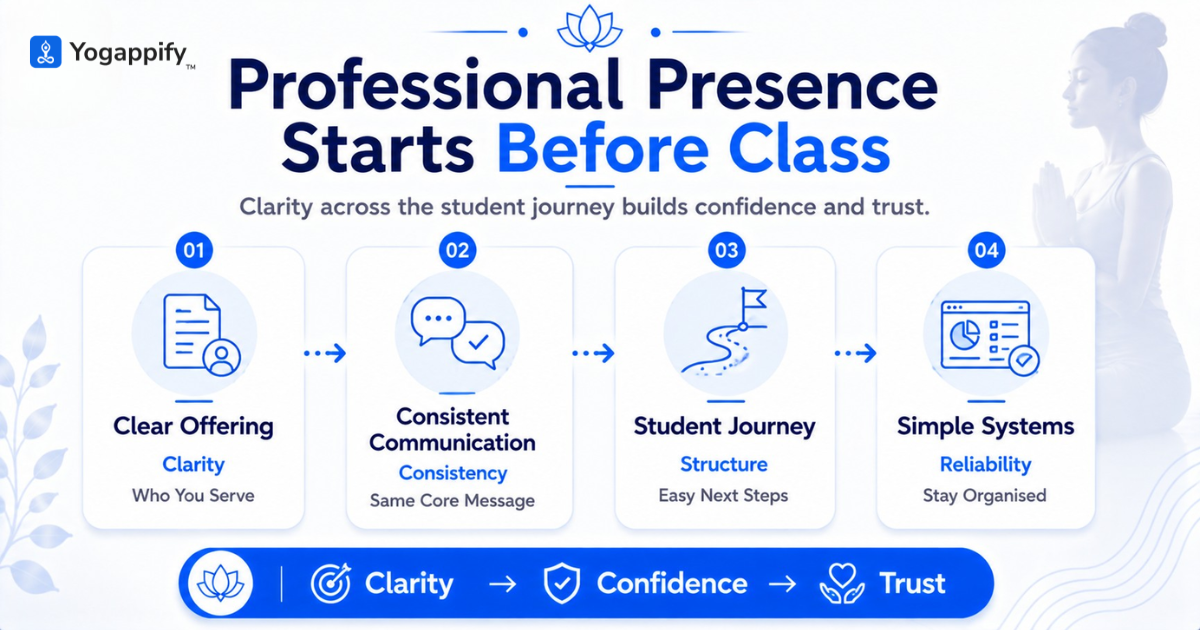
Professional Presence Changes at Every Stage
Many teachers think students judge them only after attending a class.
But students often begin forming an impression much earlier.
They notice:
- how clearly your class is described
- whether your batch timings are easy to understand
- whether your message feels calm and confident
- whether your communication is consistent
- whether your payment process is simple
- whether your follow-up feels respectful
- whether your online presence matches what you say
A student does not need perfection.
But they do need clarity.
Professional presence does not mean the teacher has to look big.
It means the teacher should not look confusing.
The First Layer: Clear Offering
The first part of professional presence is a clear offering.
Many yoga teachers describe their classes very generally:
“Yoga classes available.”
“Online and offline yoga.”
“Morning yoga batch.”
These statements are not wrong.
But they may not be enough.
A clearer offering tells the student:
- who the class is for
- what kind of practice it is
- what problem or need it supports
- whether it is beginner-friendly
- whether it is online, offline, group, or one-to-one
- how often classes happen
- how the student can join
For example:
“Beginner-friendly online yoga for women above 40 who want to improve flexibility, strength, and consistency.”
This is easier to understand than:
“Online yoga class.”
Clarity creates confidence.
And confidence helps students take action.
This is where branding for yoga teachers supports professional presence. Branding helps you become easier to understand, remember, and trust.
The Second Layer: Consistent Communication
Students respond strongly to consistency.
If your Instagram says one thing, your WhatsApp poster says another, and your phone conversation gives a third explanation, confusion begins.
Professional presence improves when the same message appears across:
- Instagram profile
- WhatsApp communication
- landing page
- class posters
- Google Business Profile
- enquiry response
- trial-class invitation
- payment communication
This does not mean every sentence must be identical.
It means your core message should remain consistent.
Students should not have to work hard to understand what you offer.
Consistent communication creates a sense of reliability.
And reliability creates trust.
The Third Layer: Structured Student Journey
A professional student experience is not only about the class itself.
It also includes the path from interest to joining.
A student journey may include:
- discovering you
- understanding your offering
- asking a question
- receiving a clear response
- attending a trial or first class
- joining a batch
- making payment
- receiving reminders
- continuing regularly
- feeling supported over time
If this journey is scattered, even interested students may drop off.
They may forget.
They may hesitate.
They may feel unsure.
They may choose another teacher who simply made the next step easier.
This is why lead generation for yoga teachers and professional presence are connected.
Lead generation creates interest.
Professional presence helps that interest move forward with confidence.
The Fourth Layer: Simple Systems
Professional presence becomes difficult when everything depends on memory.
The teacher has to remember:
- who enquired
- who attended trial class
- who needs follow-up
- who paid
- who has not paid
- which batch someone joined
- who missed class
- what message was sent earlier
In the beginning, this may feel manageable.
But as the student base grows, scattered systems create stress.
A simple system can help the teacher stay organised without becoming mechanical.
Yogappify helps yoga teachers create landing pages, manage enquiries, organise batches, track payments, and communicate with students in a structured way. You can explore it at yogappify.com.
The purpose of a system is not to make yoga teaching impersonal.
The purpose is to reduce confusion so the teacher can serve students more steadily.
The Fifth Layer: Calm and Confident Responses
Professional presence also shows up in how a teacher responds.
When students ask questions, they are often carrying small doubts:
- “Will I be able to do this?”
- “Is this class suitable for me?”
- “Can I join if I am not flexible?”
- “What if I miss a class?”
- “Is this worth the fee?”
- “Will I feel comfortable?”
A calm response builds trust.
A vague response creates hesitation.
A rushed response feels careless.
A defensive response can push the student away.
Professional communication does not mean sounding scripted.
It means responding with clarity, patience, and steadiness.
The student should feel:
“This teacher knows how to guide me.”
That feeling matters.
Professional Presence Is Not Expensive
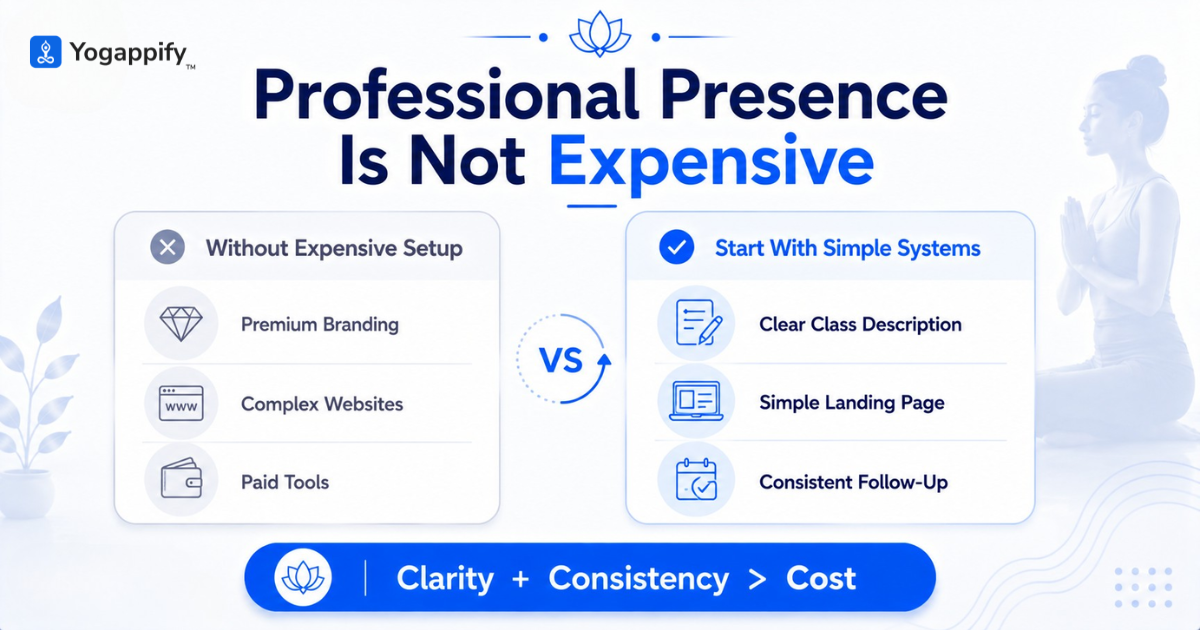
Many yoga teachers delay improving their professional presence because they assume it requires money.
They think they need:
- expensive photoshoots
- premium logos
- complex websites
- professional branding agencies
- paid software
- full content teams
These may help at a later stage.
But they are not the starting point.
You can begin with:
- one clear class description
- one simple landing page
- one standard enquiry response
- one clear poster
- one fixed follow-up rhythm
- one organised student list
- one simple payment-tracking process
Professional presence is more about clarity and consistency than cost.
A simple system used regularly is better than a beautiful system ignored completely.
Professional Presence and Pricing
Professional presence also affects how students respond to pricing.
When your offering is unclear, students compare only fees.
When your communication is clear, students understand value better.
For example, if a student sees only:
“Yoga class — ₹1,000 per month”
they may compare it with every other yoga class.
But if they see:
“Beginner-friendly yoga for working professionals who want better flexibility, posture, and stress relief, with structured weekly guidance”
they understand more.
They may still ask about fees.
But now the price sits inside a clearer value context.
This is why pricing your yoga classes becomes easier when professional presence improves.
Professional presence does not magically remove all objections.
But it reduces confusion.
And reduced confusion supports better decisions.
Professional Presence and Ethical Sales
A teacher with strong professional presence does not need to push hard.
The information itself does some of the work.
Clear class details reduce repeated explanations.
Clear next steps reduce hesitation.
Clear follow-up reduces confusion.
Clear pricing reduces awkwardness.
Clear structure reduces doubt.
That is why sales is not convincing; it is clarifying.
A professional presence helps the student make a good decision without pressure.
It gives the student enough information to understand whether the class is right for them.
This is ethical.
This is service-led.
This is aligned with yoga.
What Students Actually Respond To
Students respond strongly to:
- clarity in thinking
- clear communication
- consistent messaging
- structured processes
- calm and confident responses
- simple next steps
- respectful follow-up
- dependable class information
Clarity creates professionalism far more effectively than design alone.
A beautiful poster may attract attention.
But a clear process builds confidence.
A stylish logo may look good.
But a dependable response builds trust.
A polished profile may create interest.
But a simple and structured student journey helps people join.
Professional presence begins where confusion reduces.
A Simple Professional Presence Checklist
Before investing in anything complex, check whether these basics are clear:
- Is your class description easy to understand?
- Is it clear who your class is for?
- Are your batch timings visible?
- Is your pricing clear or easy to ask about?
- Is there one simple way to enquire?
- Do you respond to enquiries consistently?
- Do you have a follow-up process?
- Do students know how to join?
- Do students know how to pay?
- Do students receive reminders or updates in an organised way?
- Does your communication feel calm and trustworthy?
If these are unclear, begin here.
This is the foundation.
A Quiet Reflection for Yoga Teachers
If a student discovers you today:
- Will they understand what you offer?
- Will they know who the class is for?
- Will they know how to join?
- Will they feel confident taking the next step?
- Will they feel guided before they even attend?
If the answer is unclear, that is where your work begins.
Building professional presence starts with making things easier for the student to understand.
Not louder.
Not fancier.
Clearer.
Frequently Asked Questions
What does professional presence mean for yoga teachers?
Professional presence for yoga teachers means presenting your offering clearly, communicating consistently, and guiding students with structure and reliability. It helps students understand, trust, and engage with your classes more easily.
Do yoga teachers need a website to look professional?
Not necessarily. A full website is useful later, but even a simple landing page or structured communication can create a strong professional impression if it clearly explains the class, batch timing, pricing, and next step.
When should yoga teachers start using systems?
Yoga teachers should start using simple systems as soon as they begin receiving enquiries and managing students. As the student base grows, systems become important for maintaining consistency, tracking payments, following up, and reducing manual effort.
Can I build a professional presence without spending a lot?
Yes. Professional presence is more about clarity and consistency than expensive branding or tools. A clear class description, simple landing page, organised communication, and dependable follow-up can create a strong professional impression.
How can I start improving my professional presence today?
Start by clearly defining your offering. Then make sure your class description, batch timing, enquiry process, pricing communication, and follow-up are simple, structured, and easy for students to understand.
Final Thought
Professional presence for yoga teachers is not about becoming corporate.
It is about becoming clear.
When your communication is simple, your structure is consistent, and your intent is genuine, students notice it.
And when they notice it, they trust it.
That trust becomes the foundation for sustainable growth as a yoga teacher.
A student should not have to struggle to understand how you can help.
Make the journey easier.
Make the next step clearer.
Make your sincere teaching easier to trust.
That is professional presence.
Author
Vishal Ganeriwal
Vishal Ganeriwal is an entrepreneur, business strategist, and MSME mentor with nearly three decades of experience in building, managing, and growing businesses. He is part of the founding team and currently Chief Business Officer of Yogappify™, a Success Platform designed to help yoga teachers build more organised, sustainable, and professionally managed businesses. His work brings together practical business strategy, digital marketing, technology, coaching, and grassroots understanding of Indian small businesses. A long-time practitioner and certified trainer of Heartfulness meditation, Vishal believes that business growth should remain rooted in authenticity, service, and human wellbeing. Through his writing, he simplifies marketing, sales, systems, and entrepreneurship for yoga teachers who may not have a formal business background. His perspectives are shaped by lived business experience, continuous experimentation, and close engagement with independent teachers and small yoga studios. He writes to help yoga professionals earn with dignity, work with greater clarity, and create a wider positive impact through their teaching.