
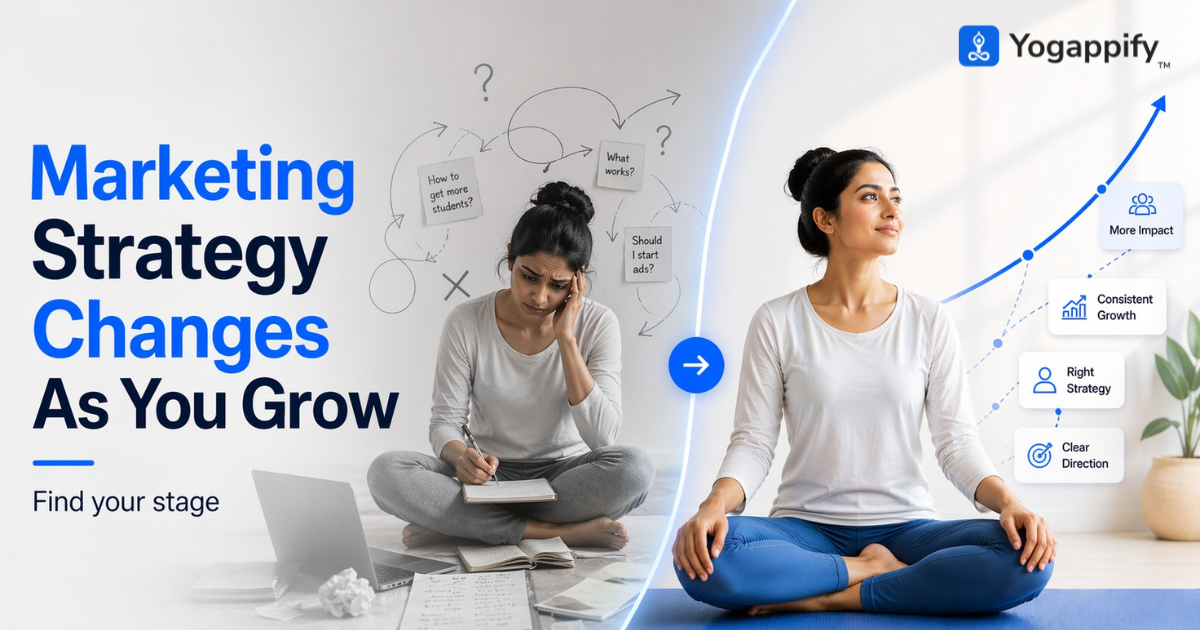

Strategy Changes at Each Stage of Growth
Many yoga teachers ask:
“What marketing strategy will work for me?”
A better question is:
“What stage am I at as a yoga teacher?”
This difference matters.
Marketing strategy for yoga teachers is not one-size-fits-all. It changes with every stage of growth.
What works when you have 2 to 5 students may not work when you already have 50 students. What works for a teacher trying to stabilise one batch may not work for a teacher managing multiple batches, trainers, or locations.
This is where many yoga teachers feel confused.
They see someone using Instagram reels, someone else running paid ads, another teacher building a website, and someone else growing through referrals. Then they wonder, “Should I also do all of this?”
Not necessarily.
The right marketing strategy is not the most popular strategy.
It is the strategy that matches your current stage of growth.
What Is Marketing Strategy for Yoga Teachers?
Marketing strategy for yoga teachers is the process of creating the right level of visibility, communication, and conversion based on the current stage of your yoga business.
It is not only about being visible.
It is about being visible in the right way, to the right people, at the right time, with the right level of preparedness.
At each stage:
- your needs change
- your constraints change
- your opportunities change
- your systems need to change
- your communication needs to mature
When your marketing is not aligned with your stage of growth, effort feels scattered.
You may work hard, but the results remain inconsistent.
You may post regularly, but enquiries do not convert.
You may run ads, but people do not join.
You may get leads, but you may not have a proper follow-up system.
This is why stage alignment is so important.
Marketing strategy should grow as your yoga business grows.
Why Yoga Teachers Need Stage-Based Marketing
Many yoga teachers make one of two mistakes.
Some start too small for too long.
They keep depending only on word of mouth even after they are ready to become more visible.
Others start too big too early.
They try paid ads, complicated funnels, websites, email tools, and automation before their offer is clear.
Both create stress.
If you use a very advanced strategy too early, it becomes expensive and confusing.
If you keep using beginner methods after you have grown, you begin to feel stuck.
The real question is not:
“Which marketing tool is best?”
The real question is:
“Which marketing tool is right for my current stage?”
That is the heart of a good marketing strategy for yoga teachers.
The Four Stages of Yoga Business Growth
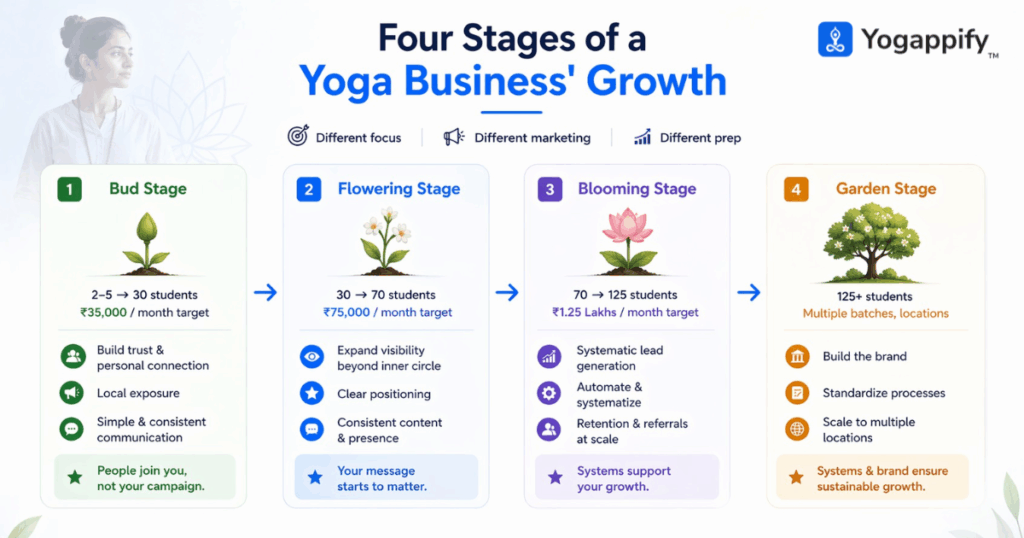
A yoga teacher’s growth can be understood in four simple stages:
Bud Stage → Flowering Stage → Blooming Stage → Garden Stage
Each stage has a different focus.
Each stage needs a different marketing approach.
Each stage needs a different level of preparation.
A simple way to remember the journey is:
Trust → Clarity → Systems → Scale
At the beginning, people join you.
Later, people need to understand your message.
After that, systems support your growth.
Finally, your brand and processes help you scale.
Stage 1: Bud Stage
2–5 Students Moving to 30 Consistent Students
Target Monthly Income: Around ₹35,000
The Bud Stage is the beginner stage.
You may be here if:
- you have just started teaching yoga
- you have a few students
- your classes are still irregular
- you are still testing your offer
- you are not yet sure which student segment responds best to you
At this stage, marketing is not about volume.
It is about trust and initial traction.
Your marketing strategy should be simple, personal, and relationship-led.
What Is Critical at the Bud Stage?
At this stage, people are not joining your marketing campaign.
They are joining you.
They want to know:
- Are you sincere?
- Are you clear?
- Can I trust you?
- Do I feel comfortable learning from you?
- Is this class suitable for me?
So your marketing should focus on personal connection.
You do not need a complex campaign.
You need a clear explanation and a simple way for people to take the next step.
What Works at the Bud Stage?
At this stage, the most useful methods are:
- referrals
- WhatsApp sharing
- local community groups
- one-to-one conversations
- direct follow-ups
- small trial sessions
- simple personal introductions
This is also where branding for yoga teachers begins to matter.
Not branding as logo and colours.
Branding as clarity.
People should be able to understand who you help, what you offer, and why your class may be right for them.
Collateral Needed at the Bud Stage
Keep things simple.
You need:
- a brief description of your classes
- a simple poster or postcard
- clear batch timing
- basic pricing clarity
- one simple way to enquire or sign up
A simple landing page can also help.
It does not need to be complex.
It should clearly explain:
- what you offer
- who it is for
- class schedule and format
- how someone can join or enquire
A simple page gives you one source of truth.
Instead of explaining the same thing repeatedly on WhatsApp, you can share one clear link.
This improves confidence.
It also gives your teaching a more professional appearance without overcomplicating your life.
Common Mistakes at the Bud Stage
The most common mistakes are:
- trying to look professional before communication is clear
- delaying launch because of perfectionism
- copying advanced teachers too early
- spending too much time on design instead of conversations
- avoiding follow-up because it feels uncomfortable
At this stage, do not wait for everything to become perfect.
Clarity matters more than polish.
Trust matters more than reach.
The key insight is simple:
People join you, not your marketing campaign.
Stage 2: Flowering Stage
30 Students Moving to 70 Consistent Students
Target Monthly Income: Around ₹75,000
At the Flowering Stage, things have started working.
You may be here if:
- you have a stable student base
- some students come through referrals
- you have begun earning regularly
- you know your teaching has value
- you now want more consistency
At this stage, your challenge changes.
You no longer need only trust from a few people.
You need clearer communication for a wider group.
The focus shifts from personal traction to clarity and consistency.
What Is Critical at the Flowering Stage?
Consistency becomes very important.
At this stage, your marketing strategy should focus on:
- clearer positioning
- regular communication
- wider visibility
- stronger student proof
- better class structure
- more dependable follow-up
Your message now matters more.
People outside your close circle may not know you personally.
They will judge your offering based on what they can see, read, hear, and understand.
This is why your professional presence as a yoga teacher becomes important.
Professional presence does not mean becoming corporate.
It means becoming clear, organised, consistent, and easy to trust.
What Works at the Flowering Stage?
At this stage, the following usually become more useful:
- regular Instagram or WhatsApp content
- simple videos
- Google Business Profile
- student testimonials
- clear landing pages
- class descriptions
- consistent posting rhythm
- referral reminders
- structured enquiry handling
You do not need to become loud.
But you do need to become visible beyond your inner circle.
Your communication should help people quickly understand:
- who you teach
- what problem you help with
- what your class format is
- what kind of experience students can expect
- how to enquire or join
This is where your message starts doing more work.
Collateral Needed at the Flowering Stage
You now need more structure around your offer.
This includes:
- class structure
- batch timing
- pricing
- regularity
- student testimonials
- landing page or simple website
- social media presence
- enquiry response process
At this stage, launching a large marketing campaign before your offer is clear can be wasteful.
First clarify.
Then expand.
A clear message can travel.
A vague message becomes noise.
Common Mistake at the Flowering Stage
The common mistake is launching too much marketing before the offer and communication are ready.
This creates scattered growth.
You may get attention, but not enough conversion.
You may receive enquiries, but the follow-up may feel unclear.
You may post regularly, but people may not understand why they should join.
At this stage, the key insight is:
Your message starts to matter more than your effort.
Effort without clear messaging can become tiring.
Clear messaging makes effort more effective.
Stage 3: Blooming Stage
70+ Students Moving to 125 Students
Target Monthly Income: Around ₹1.25 Lakhs
At the Blooming Stage, your yoga business is growing.
You may be here if:
- you have a stable student base
- referrals are coming regularly
- demand for your classes is increasing
- you are handling many enquiries
- you are managing multiple batches
- you are beginning to feel the pressure of growth
At this stage, your marketing strategy must shift again.
The focus is no longer only visibility.
The focus is systems.
What Is Critical at the Blooming Stage?
At this stage, growth can become messy if it is not supported by structure.
You need:
- systematic lead generation
- regular conversions
- student retention
- smoother enrolment
- organised batch data
- payment systems
- simple follow-up processes
- better student communication
This is where lead generation for yoga teachers becomes more structured.
Earlier, enquiries may have come through referrals and personal conversations.
Now, you need a more repeatable way to attract, capture, follow up, and convert interested students.
What Works at the Blooming Stage?
At this stage, the following methods become more useful:
- structured landing pages
- Google and Meta ads, if the offer is clear
- automated WhatsApp or email follow-up
- referral programs
- testimonials and reviews
- lead tracking
- batch and student databases
- payment reminders
- retention communication
Paid ads can work at this stage, but only if your offer, landing page, and follow-up process are ready.
Ads do not fix confusion.
They amplify whatever already exists.
If your message is clear, ads can help you reach more people.
If your message is vague, ads can simply create expensive noise.
Collateral Needed at the Blooming Stage
At this stage, you need:
- clear enrolment process
- sales funnel or enquiry-to-joining process
- batch database
- student database
- payment tracking system
- follow-up sequence
- testimonials
- referral structure
This is also where simple digital systems become important.
To scale effectively, you need a way to manage enquiries, enrolments, batches, payments, and student communication without depending only on memory or scattered WhatsApp messages.
Yogappify helps yoga teachers manage enquiries, landing pages, batches, payments, and student communication in one structured flow. You can explore it at yogappify.com.
The goal is not to complicate your teaching life.
The goal is to reduce confusion so you can concentrate more fully on teaching.
At the Blooming Stage, systems provide support rather than extra effort.
Common Mistake at the Blooming Stage
The common mistake is continuing to use informal methods while scaling.
A small number of students can be managed casually.
A growing student base cannot.
If student details, payments, batch timings, enquiries, and follow-ups remain scattered, the teacher slowly becomes the system.
That is exhausting.
At this stage, the key insight is:
Systems support your growth.
Without systems, growth creates pressure.
With systems, growth becomes easier to manage.
Stage 4: Garden Stage
125+ Students, Multiple Batches, Trainers, or Locations
At the Garden Stage, the yoga business has become successful.
You may be here if:
- you teach many students
- you have multiple batches
- you work with trainers
- you are thinking about more locations
- your brand is becoming recognised
- your systems need to become stronger
At this stage, marketing strategy changes again.
The focus is no longer only growth.
The focus is replication, consistency, and scalability.
What Is Critical at the Garden Stage?
At this stage, your business cannot depend only on your personal effort.
You need:
- brand consistency
- standard processes
- trainer onboarding
- service quality guidelines
- centralised management
- review systems
- referral systems
- collaboration and partnerships
This is where the business needs to grow beyond individual effort.
Your brand, systems, and processes must carry more responsibility.
What Works at the Garden Stage?
At this stage, the following become useful:
- consistent brand communication
- larger marketing campaigns
- partnerships
- collaborations
- centralised systems
- SOPs
- trainer onboarding procedures
- brand guidelines
- structured reviews
- strong operational dashboards
If you try to scale without standardising, quality may suffer.
Students may receive inconsistent experiences.
Trainers may communicate differently.
Payments and batches may become harder to manage.
The common mistake at this stage is trying to scale without standardising your processes.
At this stage, the key insight is:
Your systems and brand support sustainable growth beyond your personal effort.
Simple Guide: How Marketing Changes by Stage
Here is the simplest way to understand the journey:
Bud Stage → Trust
At the beginning, people join you because they trust you.
Flowering Stage → Clarity
As you grow, people need to understand your message clearly.
Blooming Stage → Systems
As demand increases, systems help you manage growth.
Garden Stage → Scale
As the business matures, brand and processes help you expand.
A simple way to remember this is:
Trust → Clarity → Systems → Scale
This is the heart of stage-based marketing strategy for yoga teachers.
Tool Usage at Different Stages
Do not use tools simply because others are using them.
Use the right tool at the right moment in the right way.
| Tool / Platform | Bud Stage | Flowering Stage | Blooming Stage | Garden Stage |
| WhatsApp for communication and follow-up | Very Useful | Very Useful | Very Useful | Very Useful |
| Instagram for content and visibility | Useful | Very Useful | Very Useful | Very Useful |
| Google Business Profile for local discovery | Useful | Very Useful | Very Useful | Very Useful |
| Landing page or simple website | Useful | Very Useful | Very Useful | Very Useful |
| Paid ads on Google or Meta | Not So Useful | Useful | Very Useful | Very Useful |
| Email or CRM tools | Not So Useful | Useful | Very Useful | Very Useful |
| Batch and student management systems | Not So Useful | Useful | Very Useful | Very Useful |
| Payment tracking systems | Useful | Very Useful | Very Useful | Very Useful |
| Yogappify all-in-one app | Very Useful | Very Useful | Very Useful | Very Useful |
This does not mean every teacher must use every tool immediately.
It means the usefulness of tools changes as your business grows.
At the Bud Stage, personal connection may matter more than ads.
At the Flowering Stage, clear communication and visibility become important.
At the Blooming Stage, systems and automation become necessary.
At the Garden Stage, centralised management and standardisation become essential.
Why Do Yoga Teachers Feel Stuck?
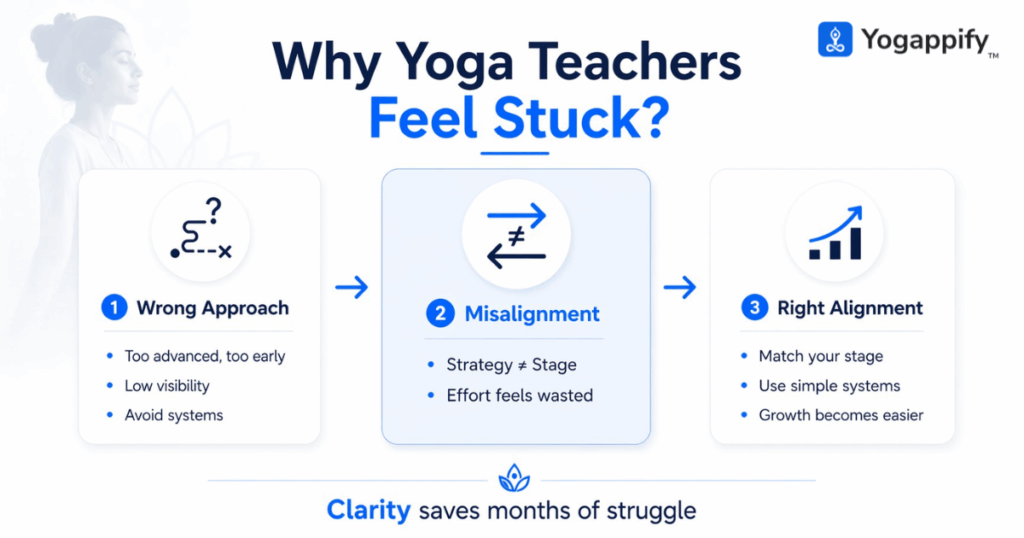
Yoga teachers do not always feel stuck because they lack effort.
Often, they feel stuck because they are using the wrong strategy for their current stage.
Some apply advanced techniques prematurely.
Some do not make themselves visible enough.
Some avoid systems when systems are required.
Some keep doing what worked earlier, even after their stage has changed.
Growth becomes easier when marketing and other business activities are aligned with your current stage.
The right strategy saves time.
The wrong strategy creates months of avoidable struggle.
Quiet Self-Inquiry
Before choosing your next marketing action, ask:
- What stage am I in right now?
- Am I trying to scale too quickly?
- Am I still depending only on personal referrals?
- Is my message clear enough?
- Do people know whom I serve?
- Do I have a simple way for people to enquire?
- Am I avoiding systems even though I now need them?
- Am I using tools because they are useful, or because others are using them?
These questions can save time, money, and energy.
Correct thinking at the right stage can save months of struggle.
Frequently Asked Questions
What is the best marketing strategy for yoga teachers?
The best marketing strategy for yoga teachers depends on the teacher’s current stage of growth. At the Bud Stage, the focus should be trust and personal connection. At the Flowering Stage, the focus should be clarity and consistency. At the Blooming Stage, the focus should be systems and structured lead generation. At the Garden Stage, the focus should be scale, brand consistency, and standardised processes.
Should beginner yoga teachers start digital marketing immediately?
Beginner yoga teachers should not rush into full-scale digital marketing or paid ads too early. At the beginning, personal connections, referrals, WhatsApp sharing, local communities, and simple communication are often more effective. A simple landing page or Google presence can help, but the main focus should remain trust and clarity.
When should yoga teachers start paid ads?
Yoga teachers should start paid ads only after their offer, message, landing page, and follow-up process are clear. Paid ads usually become more useful once a teacher has some stable students, clear positioning, and a process to convert enquiries into regular students.
How can yoga teachers attract more regular students?
Yoga teachers can attract more regular students by matching their marketing activities to their current stage of growth. They need clear communication, consistent visibility, student testimonials, follow-up, and eventually structured lead generation and systems.
Do yoga teachers need digital systems?
Yes, but the level of digital systems depends on the stage. A beginner may need only simple communication and a landing page. A growing teacher may need lead tracking, batch management, payment tracking, and follow-up systems. As student numbers increase, systems become essential for sustainable growth.
Final Thought
A strong marketing strategy for yoga teachers is not about doing everything.
It is about doing the right thing at the right stage.
In the Bud Stage, build trust.
In the Flowering Stage, build clarity.
In the Blooming Stage, build systems.
In the Garden Stage, build scale.
Do not copy someone else’s strategy blindly.
Do not use tools just because they are popular.
Do not run faster than your current structure can support.
First understand your stage.
Then choose your next step.
That is how marketing becomes lighter, clearer, and more effective.
Author
Vishal Ganeriwal
Vishal Ganeriwal is an entrepreneur, business strategist, and MSME mentor with nearly three decades of experience in building, managing, and growing businesses. He is part of the founding team and currently Chief Business Officer of Yogappify™, a Success Platform designed to help yoga teachers build more organised, sustainable, and professionally managed businesses. His work brings together practical business strategy, digital marketing, technology, coaching, and grassroots understanding of Indian small businesses. A long-time practitioner and certified trainer of Heartfulness meditation, Vishal believes that business growth should remain rooted in authenticity, service, and human wellbeing. Through his writing, he simplifies marketing, sales, systems, and entrepreneurship for yoga teachers who may not have a formal business background. His perspectives are shaped by lived business experience, continuous experimentation, and close engagement with independent teachers and small yoga studios. He writes to help yoga professionals earn with dignity, work with greater clarity, and create a wider positive impact through their teaching.