


Many yoga teachers teach sincerely.
Students appreciate their classes. Some even say, “Your class really helps me.”
And yet, financially, things feel unstable.
Income fluctuates. Savings feel thin. Rest feels expensive. The future feels uncertain.
If this feels familiar, you are not alone.
In most cases, the reason is not a lack of teaching skill.
It is a lack of structured livelihood design.
Many yoga teachers struggle financially not because they lack sincerity, discipline, or knowledge, but because teaching well does not automatically create financial stability. A stable teaching life needs clarity, pricing, scheduling, student retention, simple systems, and thoughtful income planning.
Understanding why yoga teachers struggle financially begins with recognising that great teaching alone does not create a sustainable livelihood.
Teaching skill is essential. But teaching skill alone is not a financial system.
The Assumption That Keeps Many Teachers Stuck
Most yoga teachers begin with a well-intentioned belief:
“If I teach honestly and keep improving my practice, things will work out.”
This belief feels aligned with the spirit of yoga.
But it can quietly create financial instability.
Yoga teacher training often prepares you deeply in:
- asana and alignment
- anatomy and safety
- philosophy and presence
- teaching methodology
- discipline and practice
What it rarely prepares you for is:
- pricing your work
- designing a sustainable weekly schedule
- managing recurring income
- tracking student retention
- communicating professionally with enquiries
- following up without feeling uncomfortable
- using simple systems to reduce administrative stress
As a result, many teachers enter the world prepared to teach, but unprepared to sustain themselves financially.
This is not a personal failure. It is a missing piece of training.
Teaching Well and Earning Well Are Not the Same Thing
This is a difficult but important truth.
Better teaching does not automatically lead to better income.
You can be an excellent teacher and still:
- underprice yourself
- depend on unstable studio splits
- say yes to draining schedules
- trade time for money with no ceiling
- avoid follow-up because it feels commercial
- lose students because there is no retention system
- feel unsure about how to grow consistently
This explains why yoga teachers struggle financially even when students genuinely value their teaching.
The difference between financial stress and financial stability is rarely talent.
It is structure.
Of course, your teaching quality matters. Without good teaching, no business system can create long-term trust.
But good teaching alone does not decide your income.
Your income is also shaped by how clearly you define your offering, how confidently you price it, how consistently students join, how long they stay, and how well your systems support your work.
This is why pricing your yoga classes becomes an important part of financial stability. Pricing is not only about money. It is about respecting your student, your effort, and the sustainability of your teaching life.
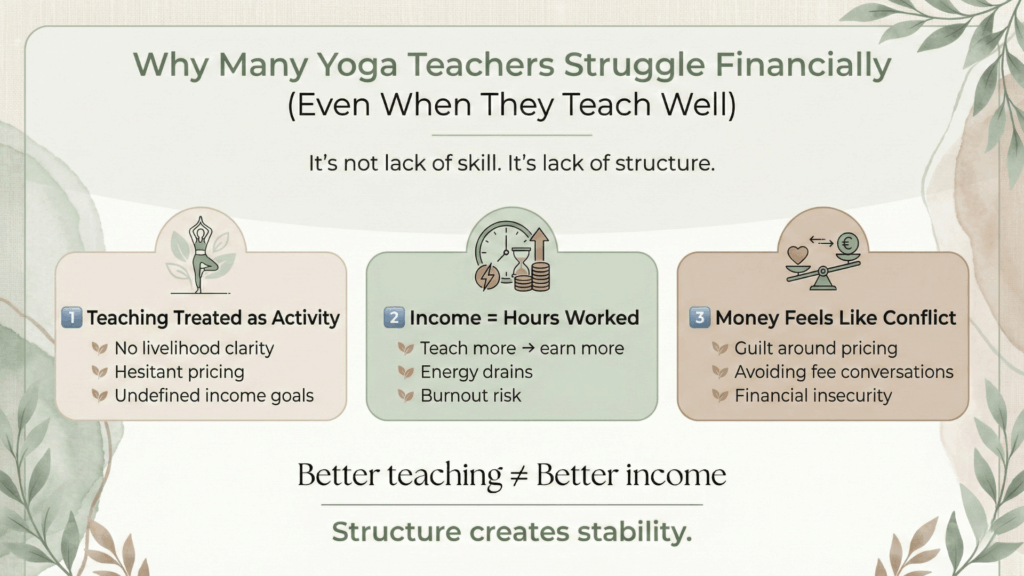
Three Structural Reasons Yoga Teachers Struggle Financially
1. Teaching Is Treated as an Activity, Not a Designed Livelihood
Many yoga teachers never consciously decide what yoga teaching is meant to become in their life.
Is teaching yoga:
- a passion project?
- a side income?
- a temporary opportunity?
- a long-term livelihood?
- a full professional path?
Without this clarity, pricing remains hesitant, boundaries stay unclear, and income expectations remain vague.
A livelihood requires conscious design.
An activity runs on goodwill and hope.
Most teachers live somewhere between the two and feel the tension every month.
This uncertainty is a major reason why yoga teachers struggle financially despite working consistently.
If your goal is to grow your yoga business sustainably, this clarity becomes non-negotiable. Before branding, marketing, sales, or technology, a teacher first needs to ask:
“What kind of teaching life am I trying to build?”
2. Income Depends Almost Entirely on Hours Worked
For many teachers, the income model is simple:
Teach more classes → earn more money.
This works only for some time.
Eventually:
- energy drops
- injuries may appear
- family time reduces
- personal practice suffers
- teaching quality may decline
- rest begins to feel like lost income
When income depends only on hours worked, growth becomes exhausting.
Without systems for batch scheduling, student communication, payment reminders, lead tracking, and retention, the only way to earn more is to work more.
This is not sustainable.
And it is one of the fastest paths to burnout.
This is also where professional presence as a yoga teacher becomes important. Professional presence is not about becoming corporate. It is about becoming clear, consistent, dependable, and easier for students to trust.
3. Money Feels Like a Moral Conflict
In many yoga spaces, there is quiet discomfort around money.
Somewhere along the way, teachers absorb the belief:
“If I care about money, I am less service-oriented.”
This belief creates hesitation.
It leads to:
- underpricing
- avoiding fee conversations
- guilt around earning well
- discomfort with follow-up
- resistance to financial planning
- fear of appearing commercial
But chronic financial stress does not protect the purity of yoga.
It quietly harms:
- teaching quality
- mental well-being
- student experience
- consistency
- long-term impact
Earning well is not anti-yoga.
Living in constant insecurity is.
A teacher who is financially stable can teach with more presence, patience, and steadiness. A teacher who is always financially anxious may slowly become tired, resentful, or inconsistent despite having good intentions.
This is why yoga teachers need to separate greed from sustainability.
Greed exploits.
Sustainability supports service.
Why Working Harder Rarely Fixes the Problem
When income feels unstable, most teachers respond by doing more.
They teach more classes. They take more certifications. They post more on social media. They say yes to more opportunities. They try to be available to everyone.
These actions may help temporarily.
But without clarity and structure, more effort often creates more exhaustion.
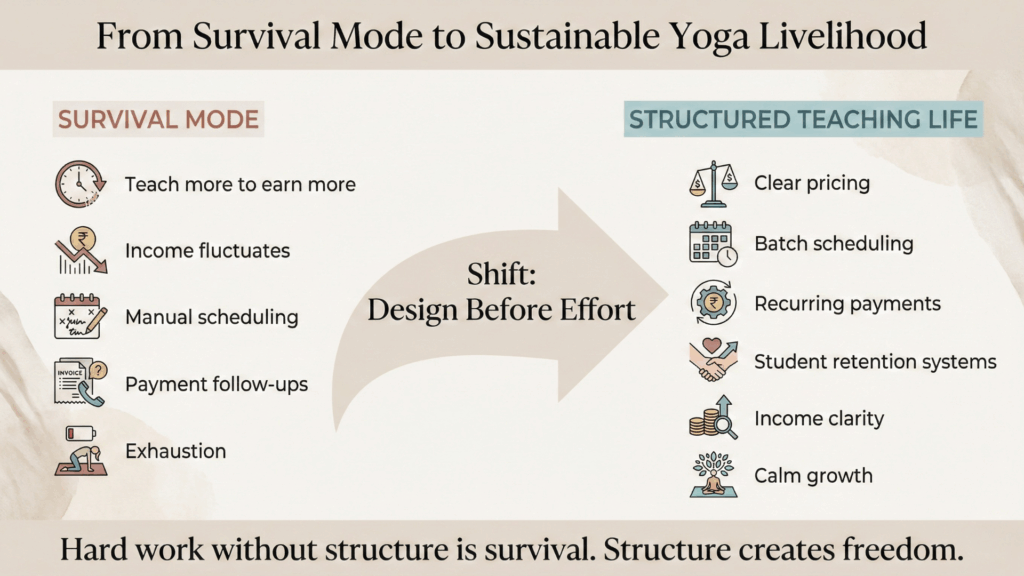
Hard work without structure is not freedom. It is survival mode.
This is another reason why yoga teachers struggle financially, despite working harder every year.
To grow sustainably, yoga teachers need more than effort. They need a thoughtful marketing strategy for yoga teachers that matches their current stage of growth.
A teacher with 5 students does not need the same strategy as a teacher with 50 students.
A teacher trying to stabilise one batch does not need the same systems as a studio managing multiple trainers.
A teacher who is still unclear about pricing should not blindly copy someone running paid ads at scale.
Sequence matters.
Clarity comes first. Then branding. Then marketing. Then sales and systems.
When the sequence is wrong, effort becomes scattered.
When the sequence is right, growth becomes lighter.
The Shift That Changes Everything: Designing a Teaching Life
Financially stable yoga teachers ask a different question.
Instead of asking:
“How can I teach more?”
They ask:
“How do I want to live while teaching?”
This question changes everything.
It invites the teacher to reflect on:
- how much income is needed to live calmly
- how many teaching hours are sustainable each week
- which students energise them
- which formats suit their life
- what price respects both student and teacher
- what systems reduce mental and administrative load
- what kind of growth feels aligned with their values
Only after this clarity does it make sense to think about:
- branding
- marketing
- lead generation
- sales
- technology
- automation
- scale
This does not mean a teacher needs a complicated business plan.
It means the teaching life should not be left entirely to chance.
A sustainable yoga livelihood is designed slowly, honestly, and practically.
Why Steady Student Flow Matters
Financial stability also depends on steady student flow.
Many teachers depend mainly on chance referrals. Referrals are valuable, but they are not always predictable.
A teacher who wants regular income needs a simple way for interested people to discover them, understand their offering, ask questions, and take the next step.
This is where lead generation for yoga teachers becomes important.
Lead generation does not mean chasing people. It means creating opportunities for interested people to discover you and begin a conversation.
Even a simple structure can help:
- a clear landing page
- a basic enquiry form
- a way to book a call or trial class
- a simple follow-up rhythm
- clear batch details
- clear pricing
- student testimonials
- payment reminders
- retention awareness
These are not separate from yoga.
They support the teacher’s ability to serve consistently.
Where Simple Systems Can Help
Many yoga teachers do not need complex software in the beginning. But they do need structure.
This gap in structure is one more reason why yoga teachers struggle financially, even when they teach exceptionally well.
They need one place where they can present their offering, capture enquiries, manage batches, track students, send reminders, and reduce repeated manual work.
Simple systems like Yogappify can help yoga teachers manage landing pages, leads, batches, payments, and student communication more systematically. You can explore the platform at yogappify.com.
The purpose of a system is not to make yoga teaching mechanical.
The purpose is to reduce confusion and free the teacher’s attention.
When the administrative load reduces, the teacher can return more fully to teaching, learning, and supporting students.
A Quiet Reassurance
If you are struggling financially, it does not mean:
- you are doing yoga wrong
- you lack discipline
- you are not meant to teach
- you are less sincere
- you should give up
In most cases, it simply means no one taught you how to build structure around your teaching.
Structure can be learned.
Slowly.
Thoughtfully.
Without selling out.
Without burning out.
Understanding why yoga teachers struggle financially is the first step toward creating stability.
If You Want Stability Without Losing the Spirit of Yoga
Designing a sustainable yoga livelihood requires:
- income clarity
- clear positioning
- appropriate pricing
- structured scheduling
- steady lead generation
- simple student communication
- ethical sales conversations
- retention awareness
- basic systems
- consistent follow-up
None of this has to be loud, aggressive, or complicated.
It can be done with sincerity.
It can be done with care.
It can be done in a way that respects both yoga and livelihood.
The deeper truth is simple:
A yoga teacher’s financial stability is not separate from their ability to serve.
When the teacher is stable, the teaching becomes more stable.
And when the teaching is stable, students benefit too.
Frequently Asked Questions
Why do many yoga teachers struggle financially?
Many yoga teachers struggle financially because teaching skill alone does not create financial stability. Stable income also requires pricing clarity, scheduling structure, recurring income planning, student retention, lead generation, and simple systems.
Can yoga teaching provide stable income?
Yes. Yoga teaching can provide stable income when it is treated as a designed livelihood rather than only an activity. Stability improves when teachers build clear offerings, sustainable schedules, fair pricing, student retention systems, and consistent communication.
Does earning well conflict with yoga philosophy?
No. Earning well does not conflict with yoga philosophy when it is done honestly and responsibly. Financial stability allows teachers to serve with more presence, steadiness, and long-term commitment.
What is the biggest financial mistake yoga teachers make?
One major mistake is depending only on teaching more hours to earn more money. Without systems, pricing clarity, retention, and structured student flow, this model can lead to exhaustion and burnout.
How can yoga teachers begin building financial stability?
Yoga teachers can begin by clarifying their livelihood goals, defining their offering, pricing thoughtfully, creating a simple student journey, building steady lead generation, and using systems that reduce administrative stress.
Final Thought
Many yoga teachers do not struggle because they lack sincerity.
They struggle because sincerity has not been supported by structure.
Teaching well matters deeply.
But teaching well needs to be supported by livelihood design.
If you want yoga teaching to become stable, sustainable, and fulfilling, do not only ask:
“How can I teach more?”
Ask a better question:
“How can I design a teaching life that supports both my students and me?”
That is where financial stability begins.
Author
Vishal Ganeriwal
Vishal Ganeriwal is an entrepreneur, business strategist, and MSME mentor with nearly three decades of experience in building, managing, and growing businesses. He is part of the founding team and currently Chief Business Officer of Yogappify™, a Success Platform designed to help yoga teachers build more organised, sustainable, and professionally managed businesses. His work brings together practical business strategy, digital marketing, technology, coaching, and grassroots understanding of Indian small businesses. A long-time practitioner and certified trainer of Heartfulness meditation, Vishal believes that business growth should remain rooted in authenticity, service, and human wellbeing. Through his writing, he simplifies marketing, sales, systems, and entrepreneurship for yoga teachers who may not have a formal business background. His perspectives are shaped by lived business experience, continuous experimentation, and close engagement with independent teachers and small yoga studios. He writes to help yoga professionals earn with dignity, work with greater clarity, and create a wider positive impact through their teaching.