

Many yoga teachers teach sincerely.
Students appreciate their classes.
Some even say, “Your class really helps me.”
And yet, financially, things feel unstable.
- Income fluctuates
- Savings feel thin
- Rest feels expensive
- The future feels uncertain
If this feels familiar, you are not alone.
In most cases, the reason is not a lack of teaching skill.
It is a lack of structured livelihood design.
Why do many yoga teachers struggle financially?
Many yoga teachers struggle financially not because they lack teaching skill, but because they lack structured systems for pricing, scheduling, student retention, and income planning. Teaching well does not automatically create financial stability without intentional business design.
The Assumption That Keeps Many Teachers Stuck
Most yoga teachers begin with a well-intentioned belief:
“If I teach honestly and keep improving my practice, things will work out.”
This belief feels aligned with the spirit of yoga.
But it quietly creates financial instability.
Yoga teacher training prepares you deeply in:
- Asana and alignment
- Anatomy and safety
- Philosophy and presence
What it rarely prepares you for is:
- Pricing your work
- Designing sustainable weekly schedules
- Managing recurring income
- Tracking student retention
- Using simple systems like a structured yoga studio management software
👉Visit: Yogappify.com
As a result, many teachers enter the world prepared to teach — but unprepared to sustain themselves financially.
Teaching Well and Earning Well Are Not the Same Thing
This is a difficult but important truth:
Better teaching does not automatically lead to better income.
You can be an excellent teacher and still:
- Underprice yourself
- Depend on unstable studio splits
- Say yes to draining schedules
- Trade time for money with no ceiling
The difference between financial stress and financial stability is rarely talent.
It is structure.
Teaching skill is essential.
But teaching skill alone is not a financial system.
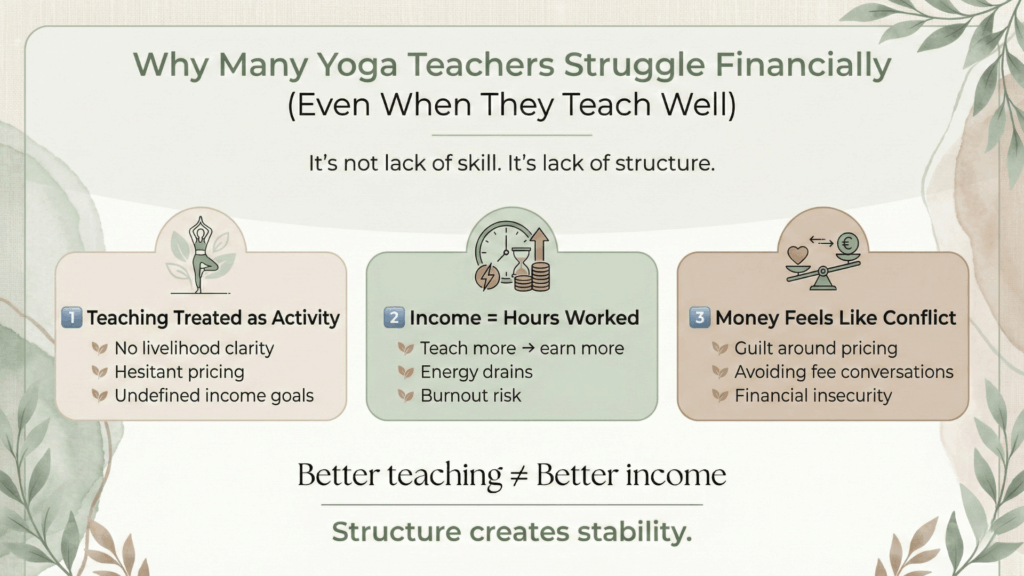
Three Structural Reasons Yoga Teachers Struggle Financially
1. Teaching Is Treated as an Activity, Not a Designed Livelihood
Many yoga teachers never consciously decide:
Is teaching yoga:
- A passion project?
- A side income?
- Or a long-term livelihood?
Without clarity:
- Pricing remains hesitant
- Boundaries stay unclear
- Income expectations remain vague
A livelihood requires conscious design.
An activity runs on goodwill and hope.
Most teachers live somewhere between the two — and feel the tension every month.
If your goal is to grow your yoga business sustainably, this clarity becomes non-negotiable.
2. Income Depends Almost Entirely on Hours Worked
For many teachers:
Teach more classes → earn more money.
This works only temporarily.
Eventually:
- Energy drops
- Injuries appear
- Personal life shrinks
- Teaching quality suffers
Without systems for:
- Batch scheduling
- Automated student communication
- Recurring fee tracking
- Retention management
- Automated yoga payment reminders
The only way to earn more is to work more.
This is not sustainable.
And it is one of the fastest paths to burnout.
3. Money Feels Like a Moral Conflict
In many yoga spaces, there is quiet discomfort around money.
Somewhere along the way, teachers absorb the belief:
“If I care about money, I am less service-oriented.”
This leads to:
- Underpricing
- Avoiding fee conversations
- Guilt around earning well
- Resistance to financial planning
But chronic financial stress does not protect the purity of yoga.
It quietly harms:
- Teaching quality
- Mental well-being
- Student experience
- Long-term impact
Earning well is not anti-yoga.
Living in constant insecurity is.
Why Working Harder Rarely Fixes the Problem
When income feels unstable, most teachers respond by:
- Teaching more classes
- Taking more certifications
- Posting more on social media
These actions may help temporarily.
But without:
- Clarity about livelihood goals
- Intentional pricing
- Repeatable systems
- Long-term income design
More effort usually leads to more exhaustion — not more stability.
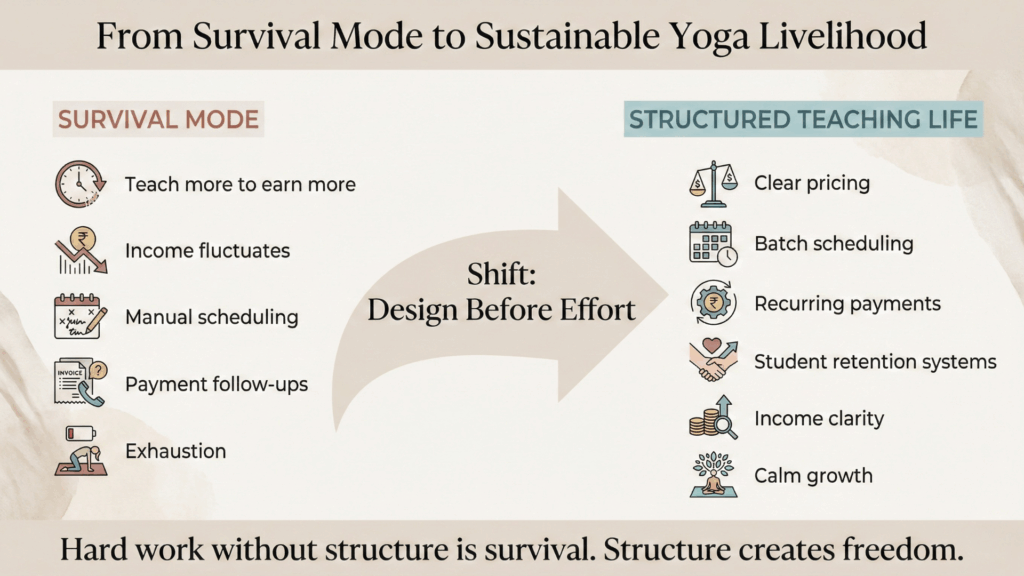
Hard work without structure is not freedom.
It is survival mode.
The Shift That Changes Everything: Designing a Teaching Life
Financially stable yoga teachers ask a different question.
Instead of:
“How can I teach more?”
They ask:
“How do I want to live while teaching?”
They reflect on:
- How much income is needed to live calmly
- How many hours are sustainable weekly
- Which students energize them
- What systems reduce mental and administrative load
Only after clarity do they think about:
- Branding
- Marketing
- Sales
- Technology
Sequence matters.
When clarity comes first, everything else becomes lighter.
A Quiet Reassurance
If you are struggling financially, it does not mean:
- You are doing yoga wrong
- You lack discipline
- You are not meant to teach
In most cases, it means:
No one taught you how to build structure around your teaching.
Structure can be learned.
Slowly.
Thoughtfully.
Without selling out.
Without burning out.
If You Want Stability Without Losing the Spirit of Yoga
Designing a sustainable yoga livelihood requires:
- Income Clarity
- Professional and Effective Marketing Strategy
- Clear pricing
- Structured scheduling
- Simple automation
- Retention awareness
If you want to explore how structured systems can reduce financial stress without increasing workload:
👉 Start here 60 day free trial link: https://yogappify.com/
Frequently Asked Questions
Is it normal for yoga teachers to struggle financially?
Yes. Many yoga teachers are trained deeply in teaching but not in pricing, systems, or income planning. This often leads to unstable earnings.
Can yoga teaching provide stable income?
Yes, when teaching is supported by structured scheduling, recurring payments, student retention systems, and thoughtful income design.
Does earning well conflict with yoga philosophy?
No. Financial stability allows teachers to serve better and teach with presence. Chronic insecurity reduces quality and impact.
What is the biggest reason yoga teachers burn out financially?
Income tied only to teaching hours, without automation or retention systems, leads to exhaustion and instability.
Author
Team Yogappify
works with yoga teachers and studio owners across India to build sustainable, structured, and stress-free business systems without compromising the spirit of yoga.